She’s gone and done it again!
The editor of Nursing Standard, Flavia Munn, has pulled off yet another zinging edition. More really interesting stuff that you won’t be able to read!
It’s a £walled magazine for nurses… and if it interests nurses, it should interest us all.
Munn’s editorial about Letby, ends;
‘… any trust that is lost will be restored because although Letby defiled her role in the most heinous way imaginable, she will never define her profession…’
Well said. I wonder what the RCN think? As far as I can tell, nothing from Pat Cullen… despite the magazine being a wholly-owned subsidiary of the Royal College of Nursing.
The Letby affair looms large over the September edition, not least in a very good article by Alison Stacey… an in-house reporter.
Stacey looks at events through the lens of culture and regulation. It’s a three page piece on background, challenges and a practical guide on how to raise concerns.
Later there are a further three-pages from health journalist Adrian O’Dowd.
I’d recommend you read both but you can’t, so I won’t.
If you know a nurse you might be able to borrow a copy. If you are a nurse director you should arrange for it to be in the Board’s weekly briefing pile.
The two articles merge around the events at Mid-Staffs and the Francis inquiry and lead us on, to today.
Their central question is implicit… why are we still in a mess when it comes to fessing-up when things go wrong.
Given the through-put of patients, the complexity of their needs and over a million people looking after them… each with their own needs, their own problems and challenges…
… of course things will go wrong…
… oversights, rudeness, bullying, expectations, sloppiness, accidents, ignorance, temperament, tiredness, misunderstandings and idiocy.
Systems will let us down, people will let us down… it’s all too obvious and to pretend it doesn’t happen is just stupid…
… but we do and we run for cover. Reputations, jobs and careers at stake.
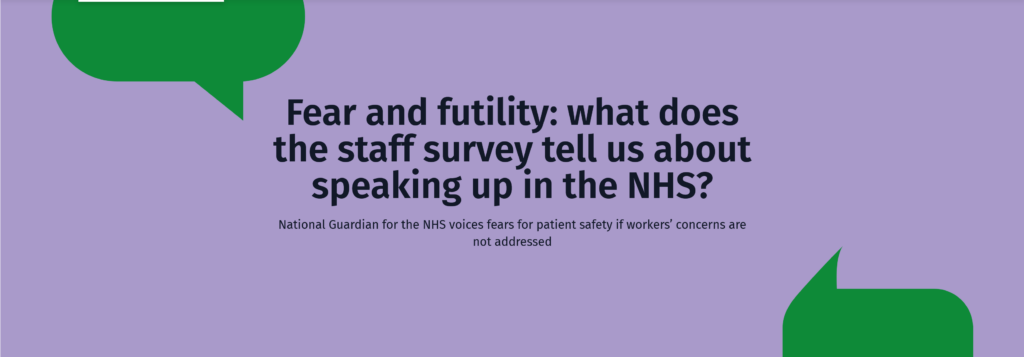
O’Dowd reports on a report, ‘Fear and Futility’ the National Guardian’s Office analysis of the 2022 NHS Staff survey.
They found that the confidence workers’ felt they had, to speak-up, was at a two years low.
The Stacey article has a critical path diagram; ‘how to raise concerns’. There are eleven decision points…
… and the NMC, CQC, NHSE, HMG, trade unions, employers and managers all have a hand in making it work…
… plus an organisation, Protect, which I’ve never heard of, who’ve been around for 25yrs, helping whistleblowers.
We all know none of this really works. We kid ourselves. We know when things go wrong, it’s easier and safer, to look the other way, keep yer head down, stay schtum.
Stacey, in her piece, calls for a change in the culture of the NHS. She’s probably right. She’s not the first and won’t be the last.
We need to be clear about four things…
What are we trying to change?
Bad behaviour, or our response to it? They are entirely different things and need different approaches. They are entwined in the NHS and the lack of clarity inhibits a clear response.
Who will lead the change and what is their commitment?
Not NHSE. Fifteen ICBs submitted plans for 2023/24 that would result in a £750m deficit.
They’ve been bullied into reviewing their staffing levels and reducing numbers. NHS England are prioritising balancing the books. More care with less money and fewer people… what exactly does their Board think will be the consequences at the sharp end of care?
Get buy-in from everyone.
That means aligning personal values with organisational values… who will do that and what are the values?
Communication.
NHS is speak down, talk across. It needs to be speak up and talk with.
Culture lives in our unconscious assumptions and we need to find a way to reframe them.
It starts at the top. NHSE must change their behaviour. That probably means a row with Bully Boy about what is deliverable and what isn’t.
Culture is made up of interlocking components; goals, roles, processes, values, communications, practices, training, attitudes and assumptions…
… changing it calls into question everything an organisation does, asks of itself and the people in it…
… and it’s a big ask.
News and Comment from Roy Lilley
Contact Roy – please use this e-address roy.lilley@nhsmanagers.net
Reproduced at thetrainingnet.com by kind permission of Roy Lilley.
Related
Discover more from The Training Network
Subscribe to get the latest posts sent to your email.