There’s a fine-line between challenging conventional thinking and creating confusion.
The Chair of NHSE, Penny Dash, appears to have crossed it for the second time in a matter of weeks.
Readers will remember only last week she did a Ratner… with her ‘dirty hands’ remark.
I have no idea why she does this. Whatever she intended, NHS staff heard something quite different. Instead of advancing the debate, the words became the story.
Now, she’s gawn-n-dunnit-agin!
This time, suggesting primary care has;
Addressing the needs of the Penny Dash primary care estate is paramount for improving patient care.
The data regarding the Penny Dash primary care estate reveals a complex picture of resource distribution.
This emphasis on the Penny Dash primary care estate has significant implications for future policy.
Understanding the Issues in the Penny Dash primary care estate
Moreover, the discussion around the Penny Dash primary care estate continues to raise eyebrows. This ongoing conversation highlights the pressing issues that the Penny Dash primary care estate facilities face today.
As discussions around the Penny Dash primary care estate evolve, it is essential to consider innovative solutions.
Furthermore, the need to address the challenges faced by the Penny Dash primary care estate has never been more crucial.
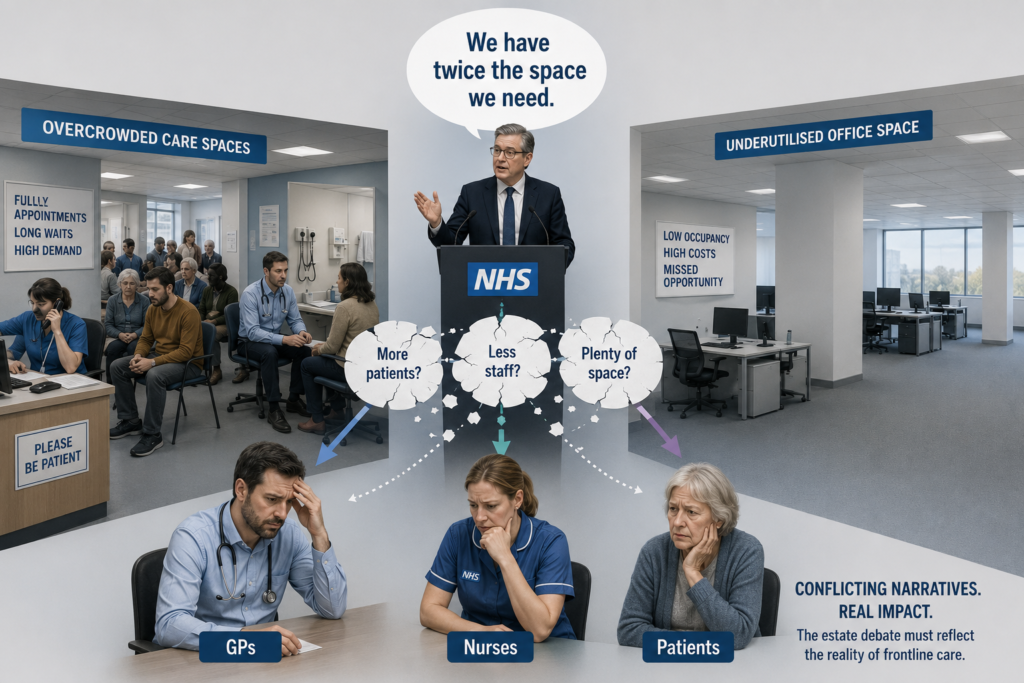
‘twice the space it needs.’
It is an extraordinary claim. Frankly… bonkers.
Not because it is necessarily wrong, but because it appears to contradict almost everything we have been told about the condition of general practice for the past decade and what to expect for its future.
Lord Darzi’s independent review concluded the primary care estate is ‘plainly not fit for purpose.’
Ultimately, all stakeholders must collaborate to enhance the Penny Dash primary care estate.
Advocating for improvements in the Penny Dash primary care estate is crucial for community health.
Long-term strategies for the Penny Dash primary care estate require careful planning.
The challenges facing the Penny Dash primary care estate must not be overlooked.
Therefore, investment in the Penny Dash primary care estate is essential for sustainable healthcare.
In conclusion, the effectiveness of the Penny Dash primary care estate will determine healthcare outcomes.
Policy changes regarding the Penny Dash primary care estate must be guided by empirical evidence.
Ultimately, the future of the Penny Dash primary care estate will shape the landscape of healthcare delivery.
The debate on the Penny Dash primary care estate continues to attract attention from various stakeholders.
Critics argue that the state of the Penny Dash primary care estate does not reflect actual demand.
Ouch, that’s awkward.
He pointed out; 20% of the GP estate predates 1948 and 53% is over 30 years old.
Very tricky, when…
… one of the Government’s own advisers says the primary care estate is holding the NHS back.
The Chair of NHSE appears to say we have twice as much of it as we need.
Those two propositions cannot occupy the same page. What are we supposed to believe?
And, by the way…
… HMG’s health policy rests on a simple proposition…
…move more care out of hospitals and into neighbourhood services.
- More diagnostics.
- More prevention.
- More chronic disease management.
- More care closer to home, and …
… it raises an obvious question.
Where’re ya gonna put it?
Neighbourhood medicine is not an abstract.
It needs bricks as well as clicks…
… consulting rooms, treatment areas, diagnostic facilities, office space, somewhere for multidisciplinary teams to meet and the flexibility to grow.
Even if more consultations become virtual, doctors on Cloud based video-calls have to sit somewhere. They can’t sit on a Cloud.
Writer, thinker and all round big brain-box Evgeny Morozov, (Who by coincidence our regular Euro-digest contributor Roger Steer, prays-in-aid, this month) writes about the temptation of big organisations to start with the answer and then organise the problem around it.
It is a trap.
Decide neighbourhood care is the answer.
Decide where’s a convenient place?
Err… general practice, where it’s clapped out, or where there’s a surplus, or where it’s chock-a-block… which is it?
Conclude there must be enough room. Job done, press on, but…
… complex systems don’t work like that.
The first question is not; where can we put the solution?
The first question is; have we properly understood the problem?
If the problem is poor utilisation of some NHS buildings, then show us (and the GPs) the evidence… have the debate.
Perhaps some buildings are underused.
Perhaps utilisation is uneven.
Perhaps Dash is referring only to parts of the NHS estate rather than every GP surgery.
We need the analysis, because… this matters. A whole policy depends on it.
If the problem is ageing premises, rising demand, more complex patients and a need to move more services closer to home… pretending suitable space is abundant doesn’t solve anything.
General practice delivers ~93% of NHS patient contacts for <11% of NHS expenditure and that share is falling, whilst demand is rising.
The NHS wants more care in the community. General practice is the community, and…
… if it’s to carry even more responsibility, it will need investment, people and premises…
… not daft ideas about spare capacity… or not… or what?
Which brings me back to leadership and the irrefutable fact…
… leaders’ words matter.
The Chair of NHSE doesn’t have the luxury of casual opinions.
Every remark sends signals to staff, patients, ministers and the media.
Every phrase is interpreted as policy.
Every interview has consequences.
That’s why judgement matters every bit as much as intellect. The ‘dirty hands’ episode should have been a warning…
… at this level, precision is not a luxury. It is part of the job.
Dash’s latest intervention risks creating exactly the same problem.
Perhaps the evidence is sound?
Perhaps the analysis is impeccable?
But… if the message leaves thousands of clinicians believing their daily experience to the contrary, has been dismissed, then something’s gone wrong, and…
… why Morozov’s warning matters.
Get the problem wrong and the solution, however attractive, will always disappoint.
There is an old saying in politics…
… when you’re explaining…
… you’re losing.
Twice in a matter of weeks, Dash has put her foot in it, and left explaining what she really meant.
That should concern all of us.
Mixed messages create a cocktail of anxiety, distrust, conflict, confusion, hesitation, delay, distancing, indecision and saps morale.
The NHS has enough problems without its leadership creating new ones.
News and Comment from Roy Lilley
Contact Roy – please use this e-address roy.lilley@nhsmanagers.net
Reproduced at thetrainingnet.com by kind permission of Roy Lilley.
Related
Discover more from The Training Network
Subscribe to get the latest posts sent to your email.