It seems to me the DH++ and the NHS is in a a period of cunctation…
Havering… shilly-shallying.
Do we press-on with the centralisation of healthcare…
In recent years, we have witnessed some remarkable NHS prevention success stories.
… contrary to the zeitgeist and Burnhamanchonia… or, do we pause, or think of something else…
…or do nothing, or do something, if only we could decide what it is.
Does Two-Clocks Cooper take on Streeting’s demolition or Lansley’s disaster… or both?
Despite her abulia (!) let’s look on the bright side this fine Tuesday morning.
This week, we mark the anniversary of Alexander Fleming’s discovery of penicillin at St Mary’s in September 1928, and a useful thought to carry into the rest of the week.
A discovery (or development and particularly a tech-something) becomes valuable, only when someone can use it. That takes people, organisation, persistence and a way of getting ‘it’ to those who need it.
The NHS does that every day, and…
… some of its most encouraging achievements deserve a much bigger audience.
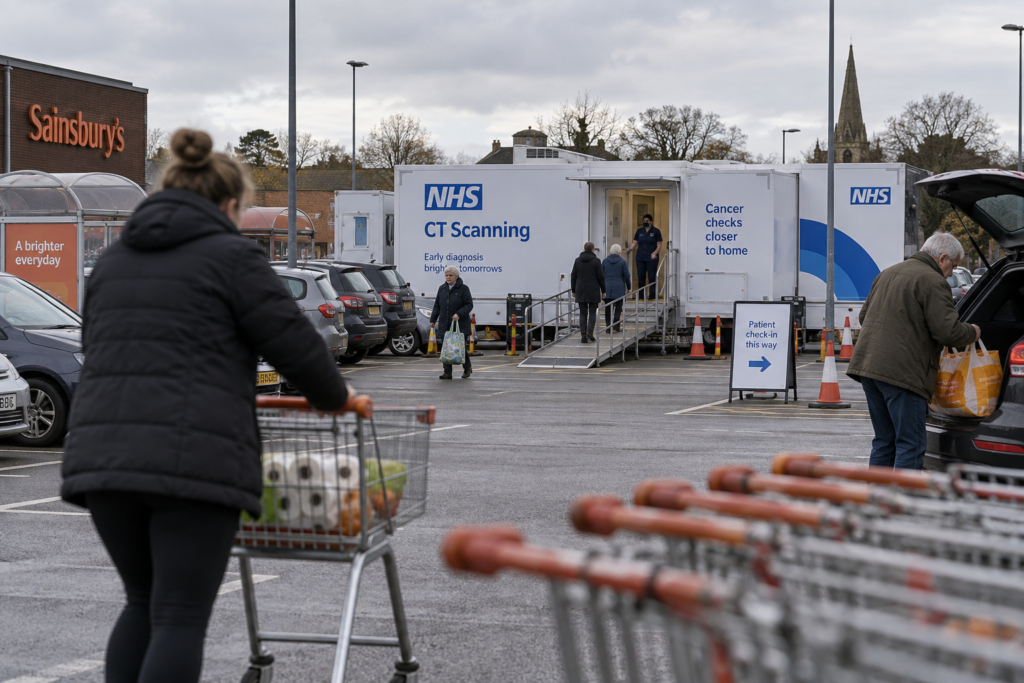
Let’s start where you are likely to be, if not today, then sometime this week. In a supermarket car park!
The NHS has been taking lung scanners into local communities, making it easier for people at risk to get checked.
By May this year, England’s programme had detected more than 10,000 lung cancers…
… more than three quarters were found at stages one or two. Behind those numbers are people whose illness was found while treatment had a better chance of success.
There’s a practical lesson here.
Convenience matters. Where we put a service can help determine who uses it.
Today you might be on the school run. Spare a thought for school vaccination.
Research found cervical cancer rates were 87% lower among young women offered the HPV vaccine at twelve or thirteen, than among comparable women born earlier who had not been offered it.
Think about the work behind that result;
- Consent forms.
- School visits.
- Nurses answering questions.
- Records maintained.
- Programmes sustained over years.
- Patient, organised work…
… with an extraordinary return.
There is good news in diabetes, too.
The NHS Diabetes Prevention Programme offers people at high risk continuing help with food, activity and weight.
NHSE says; people completing it reduce their risk of developing type 2 diabetes by more than a third.
Prevention becomes much more convincing when we can point to a service that is already doing it, and …
… there is a newer success.
The RSV vaccination programme helped reduce hospital admissions associated with the virus by a third among people aged 75 to 79 during its first winter.
That is a huge achievement for a programme only introduced in September 2024.
Fewer people seriously ill.
Fewer families facing the worry of a hospital admission.
A practical contribution to managing winter demand.
These achievements all have something in common.
They depend on good science and on the everyday skills of people who make services work.
They need;
- invitations that arrive,
- appointments people can attend,
- staff who explain, and
- follow-up that happens, and…
… they also need time.
The benefits of a vaccination programme or a prevention service accumulate long after the launch announcement has disappeared.
For leaders, that suggests a useful agenda;
- find out what works,
- find out why,
- find out ways to support the people delivering it and
- find out ways to help it reach more people.
For the rest of us, it is a reason to say thank you…
… to the nurse with the vaccine. The team in the scanning truck. The person helping someone change their eating habits. The administrator who gets the invitation to the right address.
Fleming’s anniversary gives us a moment to celebrate discovery.
The NHS gives us reasons to celebrate…
… what real people do with it!
_______
Oops… I nearly forgot; Hep C
News and Comment from Roy Lilley
Contact Roy – please use this e-address roy.lilley@nhsmanagers.net
Reproduced at thetrainingnet.com by kind permission of Roy Lilley.
Related
Discover more from The Training Network
Subscribe to get the latest posts sent to your email.