There’s a report coming out this week…
Understanding NHS productivity and patient pathways is crucial for efficient healthcare delivery.
This report will highlight key insights into NHS productivity and patient pathways.
Improving NHS productivity and patient pathways is essential for better patient care.
… from Anita Charlesworth and friends at the Health Foundation. It’s embargoed so I can only tell you it’s about productivity, and …
… particularly focusing on NHS productivity and patient pathways.
Niall Dickson and I have done a podcast with Anita…
This post will focus on NHS productivity and patient pathways to explore their impact.
We must discuss NHS productivity and patient pathways in detail.
Case studies on NHS productivity and patient pathways can provide valuable lessons.
… watch this space.
The future of NHS productivity and patient pathways looks promising with new strategies.
The Health Foundation are the John Lewis of think tanks, elegant and aspirational…
NHS Productivity and Patient Pathways: A Critical Examination
… I sometimes think we need a B&Q approach? Nevertheless the report is a cuppa-builder’s read, and…
… reminds me of a sadly overlooked Dutch computer scientist who died over twenty years ago, whose work has something very useful to tell us about productivity.
Improving NHS productivity and patient pathways can lead to significant healthcare savings.
Stay with me!
Dijkstra devised an algorithm for finding the shortest route through a network.
Think GPS in yer car; lots of possible roads between here and where you want to be. Each road has a ‘cost’ attached to it… distance, time, difficulty. Dijkstra’s algorithm works out the least-cost route from A to B.
OK, forget roads… think NHS.
Symptoms… GP… bloods… referral… outpatient… scan… another outpatient appointment… diagnosis… treatment… rehabilitation… home.
That’s a network. Every connection and interface has a cost… not just money;
- Time.
- Delay.
- Travel.
- Anxiety.
- Duplication.
- Risk.
- Error.
- Staff-hours.
- Lost days at work.
NHSE requires a 2% productivity improvement, every year, for three years…
… calculated by dividing Activity Growth by Spend Growth. If a trust increases the care it delivers by 5%, while its costs only rise by 2%, the index goes up.
Feedback from staff can enhance NHS productivity and patient pathways.
Technology plays a key role in NHS productivity and patient pathways improvement.
Research shows that NHS productivity and patient pathways are interlinked.
Last year there was a 2.7% productivity increase, but…
The ONS, says it was 1%.
Wot’s true? Dunno… but I do know…
… the wider economy productivity’s been growing at x̄ 1.1%. So, tell the nay-sayers to £^&%-off.
and…
… there’s something else… William Baumol …
… he pointed out what became known as the cost disease.
Some work lends itself to productivity improvement…
… a factory that once needed a hundred people can use robots and need ten, but…
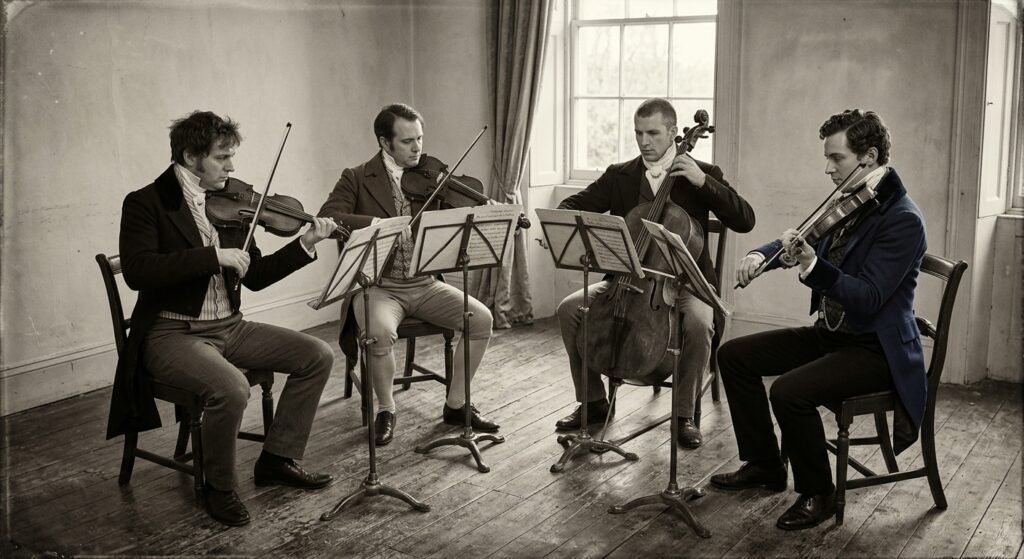
… a string quartet playing Beethoven still needs four musicians and broadly the same amount of time it needed two hundred years ago, and…
… their wages and costs keep pace with today’s wider economy…
… we pay more for what we got two hundred years ago!
Healthcare has a lot of Beethoven in it.
There are a lot of things we do for patients that will always take the same amount of time today, as it did when Florence did it.
Examining a frightened patient, explaining a cancer diagnosis, helping someone out of bed after surgery, feeding a confused elderly person, delivering a baby…
… there comes a point when doing it faster isn’t productivity and it’s not feasable.
It’s a risk… which is where Dijkstra meets Baumol…
… are we looking for productivity in the right place?
We measure theatres. Beds. Clinics. Staff. Scanners. Appointments… every stop on the patient’s journey.
Dijkstra would ask a different question. Is this the shortest journey?
Why does a patient;
wait to see a GP,
wait for a hospital appointment,
wait to see a consultant,
wait for a scan and then
wait to see the consultant again?
Could the route be…
GP→diagnostic→specialist→treatment?
One junction disappears.
An elderly person who falls;
Home… ambulance… A&E… assessment… admission… ward… discharge team… home.
Could the route be…
Home→urgent community response→
assessment→treatment→home?
The productivity gain isn’t necessarily making any one person work harder…
… it comes from removing interfaces and miles from the journey.
You can have an exquisitely productive diagnostic centre and still people queuing and after, waiting months to be diagnosed and treated.
You can have efficient hospitals, efficient GP practices and efficient community services and still have an inefficient NHS.
Optimising the parts doesn’t necessarily optimise the whole.
Understanding the nuances of NHS productivity and patient pathways is vital.
NHSE recognises the problem. Its planning framework says conventional productivity measures based on things such as unit costs, activity and workforce can actually penalise organisations for shifting care into more appropriate settings, and…
… says it’s developing measures that better recognise prevention and the left-shift.
Productivity shouldn’t principally mean… how many patients did we process?
Productivity should mean… how quickly and safely did we get someone from needing help to being helped?
AI and better data add huge interest…
… if we knew capacity, we could calculate waiting times, diagnostic availability and clinical need in real time, and the best route through healthcare for each patient?
Not necessarily the nearest hospital.
Not necessarily the traditional pathway, but…
The best route.
Baumol tells us there are limits to musicians playing and nurses caring.
Dijkstra tells us we can make the journey much shorter.
Ultimately, the goal is to maximise NHS productivity and patient pathways.
Maybe the NHS has spent too long measuring the efficiency of the stops.
It’s time we measured the journey.
Let’s ask Anita.
News and Comment from Roy Lilley
Contact Roy – please use this e-address roy.lilley@nhsmanagers.net
Reproduced at thetrainingnet.com by kind permission of Roy Lilley.
Related
Discover more from The Training Network
Subscribe to get the latest posts sent to your email.