It was unusual.
A political announcement made at eight o’clock in the morning.
Why did Chancellor Reeves choose that time?
Because she wasn’t talking to the public, who pay the bills with higher taxes. The majority of them would be at work, or well on their way. She was talking to ‘the markets’…
… who can cause havoc if they don’t get their own way.
It sort of worked? The £ took a dive. Bonds seemed unabashed and the upshot … what we knew already…
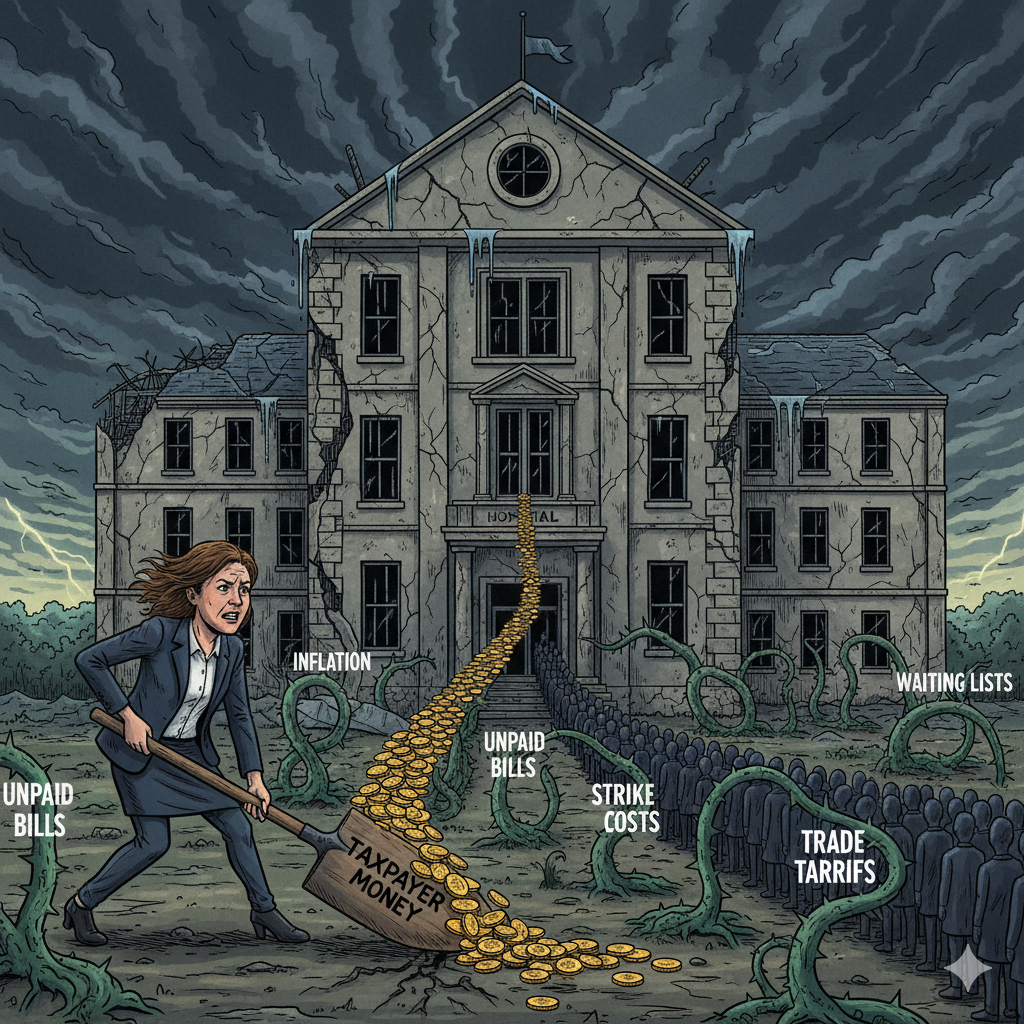
… Reeves has to dig herself out of a hole, using the taxpayers’ shovel.
Reeves didn’t say it but we know taxes will rise… the important bit being what she did say; tax rises, in part, to ‘protect the NHS and reduce waiting lists.’
A lot of people will say; Nooooo, ‘not more money for the NHS!’ We may have to do some ‘expectation management’.
How much money? Dunno but it was clear new money is coming, but…
… I can’t imagine Sir Jim opening a celebratory bottle of Newcastle Brown Ale just yet.
The NHS is already working flat-out. Any fresh funding will have to fight its way through a dense undergrowth of existing pressures before it delivers a single extra appointment.
The first call will be the unpaid bills.
The cost of the last junior doctors’ strike is still hanging over the service. It’s about £300m.
More strikes are looming. Streeting is belligerent and provocative and will dig himself deeper into the hole he is already in.
The resident doctors will catch the whiff of new money, double down and make his life hell.
Staff pay is the single largest item in the NHS budget. Morale and retention are fragile. Inflation is eroding pay packets.
Which brings me to; inflation and tariffs.
The NHS is a huge importer of pharmaceuticals, devices, reagents and disposables.
Charmer’s trade deal with the US currently does not guarantee pharma exemption. There is the prospect of 100% tariffs in the offing.
Add in global supply costs, energy and the sheer weight of inflation in the system… large parts of the new funding will disappear simply to keep services running up the down escalator.
Then… the elephant in the room… a herd of elephants… waiting lists.
Cut waiting lists? Easy, more people doing more stuff but…
… without huge technology breakthroughs a hip operation will always take up to a couple of hours and an MRI scan for prostate cancer, all up, about an hour.
That means…
… more scanners, more operating theatres, more skilled people. If you want to sweat the assets, run the system hot, 24-7… you’d probably find patients who’d turn up at 3am on a Sunday morning but you can’t do it without skilled people.
Use the private sector? Sure but it’s dinky compared to the NHS and the consultants are all NHS people.
Think; overtime, weekend sessions and temporary staff, which cost more but change nothing long term.
Much of the NHS estate is crumbling. There’s probably a £15 billion maintenance backlog. Staff working under leaking roofs, broken lifts, unsafe wards.
Modernising buildings and replacing outdated diagnostic equipment is unavoidable but slow and capital intensive. The public won’t see immediate benefits.
Digital systems are another money magnet.
Politicians talk about ‘modernising the NHS’ through AI, shared records and automation but we know, the digital budget will be swallowed up by catching up — making old systems talk to each other and replacing obsolete kit.
Everyone agrees on the need to shift care into the community and invest in prevention but that takes time and people and the workforce plan is stalled. It won’t win short-term headlines.
Waiting lists are the people’s priority.
In reality, the Chancellor’s extra money will largely fill holes, not build new foundations. Most of it will go on pay, inflation and keeping the show on the road.
This is firefighting.
Silly Boy’s made all the wrong decisions at the wrong time… should have really focused on waiting from day one.
Now, he’s stuck with redundancy costs for a chaotic reorganisation he can’t not finish, an unaffordable 8.5-year plan he can’t start…
… a row with the doctors he doesn’t know how to end and nowhere near the beginning of sorting out social care.
Will more money buy him some breathing space?
Don’t hold yer breath.
News and Comment from Roy Lilley
Contact Roy – please use this e-address roy.lilley@nhsmanagers.net
Reproduced at thetrainingnet.com by kind permission of Roy Lilley.
Related
Discover more from The Training Network
Subscribe to get the latest posts sent to your email.