I came away with more questions than answers.
I did the nuclear physics thing. The protons and neutrons. Histology whizzed past, before coffee.
DNA… easy. A machine the size of a laundromat-tumble-dryer, hummed away, busy defining the hidden route-map to someone, or somebody or some thing.
A swish looking piece of kit, ergonomically seductive with neon lights.
You can have one if you’ve got a million quid.
Don’t bother, soon it will be redundant…
… replaced by a pocket size version… half the size of an iPhone. They’ll be in the practice, on the wards, the supermarket, the corner shop…
… DIY-DNA…. It’ll be a thing.
Why? Well that’s a good question.
Like most of us I live my life in the comforting oblivion of ignorance. Do I really want to know if one of my bits is going rotten, or something will fall off?
And, if we did know… who would we tell?
A partner, who could be saddled with a crumbling old geezer. They might take fright.
An insurance company… well, you know what they’re like… you can insure against flood only if you live at the top of a hill, but not next to a river.
Will insurers do a deal if you’ve got some dodgy DNA… the Equality Act 2010 might need a tweak.
Then there’s the NHS. What will they do?
They speak loftily of personalised medicine. Cures, bespoke and tailored. They’ve no idea what it means.
No concept of how the infrastructure of the NHS will be dismantled. Demolished might be a better word. How will the NHS cope with a sublime and uncomfortable future?
Dunno…
Cancer… treatment and cures cannot rely on jumble sales and mum running a marathon. It won’t have to.
The prospect of cancer, an attenuation, a fix, a cure, an understanding of the invisible silent killer that creeps into our lives and assassinates the ones we love…
… it really will be consigned to the past. As rare as scurvy.
How will the NHS cope, with a system that has changed very little since 1948. Primary care, secondary care, pharmacy and all the rest. A new era is knocking on the door.
Our needs and cures, individual and particular.
Bioscience and technology, isn’t the future. Most of it is in the here-and-now…
… but I have no idea how it fits into what we have. A supercar in a Cortina era. A jack-plug with a USB socket. We struggle and stumble along. Muddling through.
Unbeknown to most of us, there is a place, a citadel we can see, that lives in the future.
To find it, swish through the revolving door. The greeter on the desk… with a welcoming-smile and a look that infers they have known you for a life time…
… this place reeks of class.
Goose-bump stylish. An elegant efficiency, backed up with an electricity in the air. Walk in and prepare for a hair on the back of the neck moment.
A temple, a Mecca. Where finding out, is found out for finding out’s sake. The joy of knowledge.
As they say of themselves; discovery without boundaries.
A place where, for every vacancy there will be 3,000 applicants.
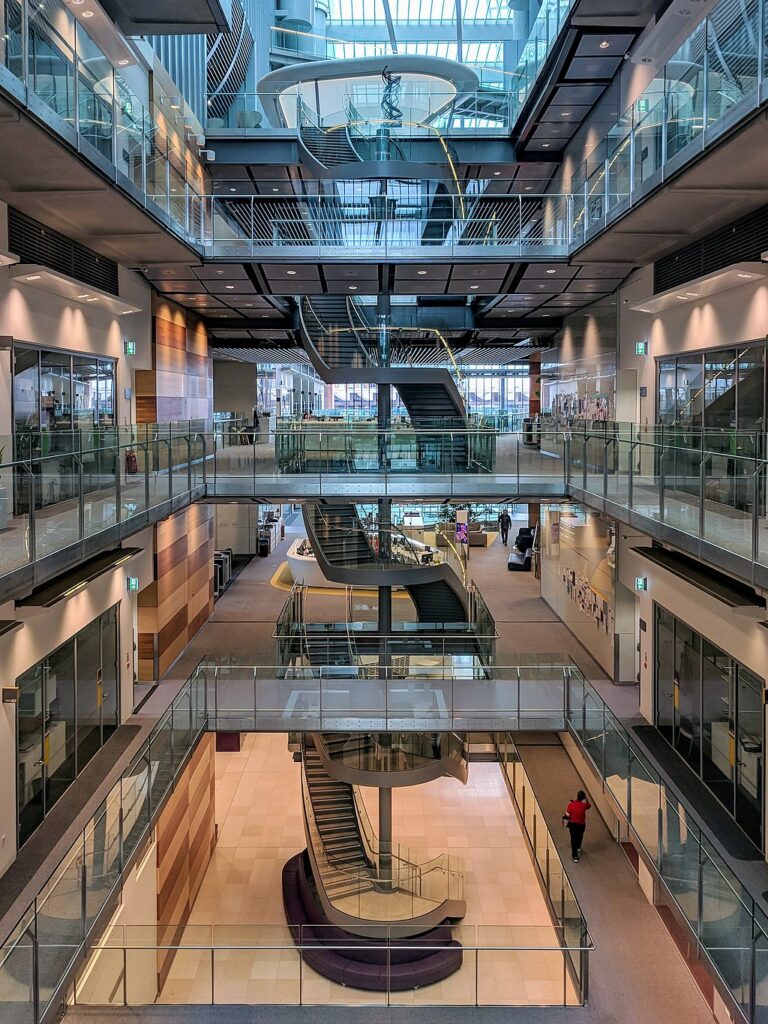
Designed with meticulous attention to detail. The exterior elevations broken up to disguise its mass. Interiors with light and space that creates scale and intimacy…
… with input from scientists, local residents and community groups, the building supports the goals of the organisation, promotes public engagement and brings in local kids to learn about science.
A third of it below ground…
… protecting equipment more delicate than a Ming vase, from the vibrations of London’s traffic and trains.
Energy, created as a by-product of powering the buildings,is used to heat it. Its ‘brown roof’ of native plants helps to insulate the building and provides habitats for wildlife.
I am at The Francis Crick Institute, in London.
The Crick can photograph the smallest thing, sitting on the back of the smallest thing, making what we thought was the smallest thing look like a block of flats.
They can peer into the heavens.
Paint us pictures in 3-D, of the world’s most dangerous diseases. Waltz them across a screen… all it needs is the computing power of a small country… and they have it.
Self contained, elegant. To work there is to belong to a tribe. Exclusive, educated, qualified but human enough to spend time with an outsider like me.
With its atriums and vaulted roof space, The Crick is built like a cathedral. Its work takes us to the edge of spiritual, origins, genesis.
Like I said, more questions than answers.
I realised life is no longer limited by what we can do.
We are limited by what we do, with what we can do.
-oOo-Thank you to everyone I met at The Crick, for giving me your time and sharing your optimism for a better future.
News and Comment from Roy Lilley
Contact Roy – please use this e-address roy.lilley@nhsmanagers.net
Reproduced at thetrainingnet.com by kind permission of Roy Lilley.
Related
Discover more from The Training Network
Subscribe to get the latest posts sent to your email.