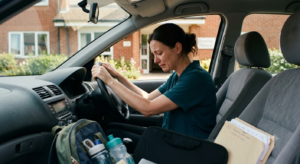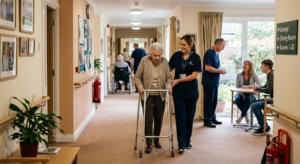
Bob knew it’d happen.
He told Shirley… his wife of 32 years… ‘I’ll be late’.
Shirley’s a nurse. She sent her man off, to his shift, with the left-hand pocket of his EMS jacket stuffed with a cheese and pickle sandwich.
Shirley’s a dab hand at cheese and pickle…
… Canterbury cheese, Heinz Piccadilly, a couple of crisps for-crunch and always brown bread.
Total calories?
Who’s counting.
Bob started at three-in-the-afty. His first blue-light was to the Westover Estate.
A tower block. Seventh floor.
Who’s counting?
Bob and his partner Amy took one look at Tom, sprawled on the kitchen floor… fragility-hip-fracture. One of around 75,000 each year in the UK.
Tom’s neighbour found him. He’d been there since about three in the morning… got up to have a pee… tripped over the the carpet… that was that.
‘Lucky’, his little terrier, barked and barked and barked. The neighbour knew there was something up. Eventually, forced the front-door. Rang for an ambulance. It took three minutes under four hours… category two.
By now, Tom had been on the floor for the best part of 12 hours.
Who’s counting?
After a lot of huffing and manoeuvring Tom was on his way to hospital… where the problems began.
Tom was hoiked out of the ambulance, number eight in the queue of fifteen. Into A&E. X-rayed and returned to the ambulance for Bob and Amy to keep a watching brief.
More ambulances arrived. It’s just like last year.
Who’s counting?
That was when the cheese and pickle sandwich came into its own. If it were a piece of furniture, it would be Chippendale.
By eleven Bob wished the other pocket had been stuffed with 5,000 calories as well.
Crew change-over eventually happened on the ramp outside A&E. Bob went back to Shirley and they swapped stories about their day.
Overwhelming numbers…
Whose’s counting?
Why, oh why… is Bob and Amy and Shirley and Tom and for all I know, you, in this mess again?
No Mensa brain required. There’s a lack of capacity in our hosptials and social care has whithered on the vine.
Add-in strikes and you have a pickle… and we’re not talking sandwiches.
Who is counting?
Who’s is really counting? Counting capacity… the number of beds we need. The answer is; a lot of people but they’re counting the wrong things.
Capacity is at the heart of our problems.
For years we’ve been forecasting the number of beds on the basis of the growth in population, age and some mumbo-jumbo about how advances in technology will reduce length-of-stay.
In international comparisons our length of stay is low. Is that good?
Dunno…
Virtual beds? Well, ‘putting up beds’ in hospital is cheap. People is the problem.
Patients in virtual beds, their own beds, are actually likely to need;
• NHS management with a pretty high risk-appetite
• higher-banded staff,
• technical support and ‘show how’,
• kit with maintenance and replacement services,
• consultant supervision,
• social services,
• meals-on-wheels
• pharmacy services
• OT assessment and
• installation of adaptations
• hopefully some handy relatives for shopping
• a community something or other when things go wrong…
… preferably not an ambulance or a community nurse…. because they are already busy.
Virtual is not a get out of jail. Do some counting.
We are obliged to use this fall-back because bed calculations are based on the wrong formula… or so says Dr Rodney Jones, who for years has been plotting and comparing hospital performance.
… he’s been counting.
He says the key to the number of beds hospital systems need is… death.
Death is not a variable. Unlike the beds for youngsters who fall off their motorbikes. Death… is worth counting.
The majority of our health care consumption will be when we are dying, regardless of age… some people fall of their Hondas and never get up.
Death is a proxy for lifetime use of the NHS.
Jones says;
‘… calculate the ratio of beds per 1,000 deaths and adjust it for deaths per 1,000 population and you will have the number of beds you need for your population…’
… and a fantastic method for international comparison.
I’ll pause whilst you read that again…
If Jones’s been counting right, the number of beds we have now will need to increase by;
• around 6% for the summer and
• 9% for the winter just to enable patient flow,
• 1% per annum after that, to account for the growth in deaths over the next 30 years,
• and a sizeable temporary allocation just to clear the waiting list backlog.
Only then, says Jones, will you be able to calculate the numbers you need for safe staffing, then a proper workforce plan and then be able to figure out your real costs.
It looks to me like you can count on it.
Have the best weekend you can.
Related
Discover more from The Training Network
Subscribe to get the latest posts sent to your email.