About fifteen minutes from the Eiffel Tower, just three hours from most European capitals…
… Paris Expo, Porte de Versailles. This year the home of Sante Expo.
And… the leading event of the French Hospital Federation. They’ve been doing it since 1966.
We don’t have anything like it. Probably, the nearest comparable is Medica in Düsseldorf… which is actually bigger in terms of kit-n-caboodle but without the presentation content in Paris.
Here’s an extract from one of the Expo sessions:
‘… The rise in violent incidents at hospitals and doctors’ offices has led clinicians to be on constant lookout for ways to keep themselves safe while caring for patients…
… over 50 hospital workers attended a session… by psychologist Yves Peiffer, director of clinical practice and development at the Crisis Prevention Institute, a provider of evidence-based de-escalation and crisis prevention training.’
Their numbers are pretty horrible.
Since 2005, the French Ministry of Health’s National Observatory on Violence in the Healthcare Sector has collected voluntary reports of attacks against people and property at hospitals and doctors’ offices.
In 2021, there were over 19,000 reports of nearly 37,500 incidents or acts of varying severity.
Peiffer’s central theme was;
‘Let’s all be kind! Behaviour influences behaviour.’
He tells us; there’s ‘no switch we can flip to stop someone from being aggressive’. The one thing we do have control over is our own behaviour… we can use it to calm the person in front of us.”
Good advice I’m sure but hard to remember when your dealing with a six-foot, drunken thug on a Saturday night with an A&E boiling up with people, hacked-off with waiting…
It’s a global problem.
The WHO report;
‘… up to 38% of health workers suffer physical violence at some point in their career…’
And…
‘… Violence in [the health] sector may constitute almost a quarter of all violence at work.’
Their guidance is a bit pedestrian but covers the bases and is worth a look.
Frustration and anger arising out of illness and pain, psychiatric disorders, alcohol and substance abuse, can affect behaviour and make people verbally or physically violent.
The incidence of violence faced by workers in contact with people in distress is so common that it is often considered par-for-the-course.
Waiting seems to be a trigger.
Waiting for an ambulance, waiting for an appointment or for A&E assessment and the perception someone has ‘jumped the queue’.
The situation in England is very well up-summed, in an excellent article in this month’s Nursing Standard.
It’s the house magazine of the RCN and can’t be read without a subscription, which is a shame because it is always cracking-good.
Erin Dean is the journalist. (Twitter)
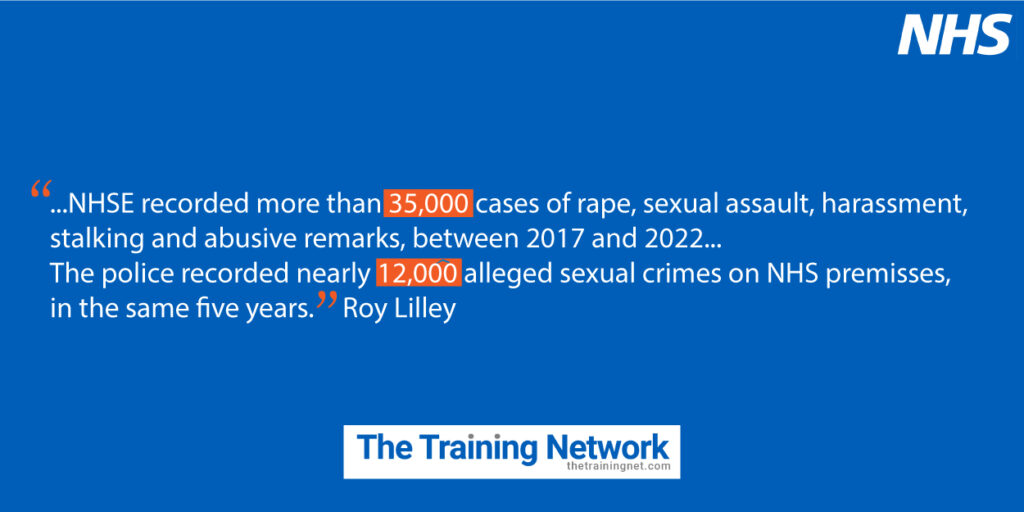
She tells us; NHSE recorded more than 35,000 cases of rape, sexual assault, harassment, stalking and abusive remarks… between 2017 and 2022…. I make that 135 a week. About 20 a day.
The police recorded nearly 12,000 alleged sexual crimes on NHS premisses, in the same five years.
Unison don’t hold back. They say;
‘… assaults against NHS staff are rising with around 75,000 people each year experiencing physical violence & aggression from patients, relatives or public.’
Apart from cutting waiting, making waiting environments more pleasant and teaching staff how to diffuse aggro…
… there’s not much in the way of, ‘if you were a partner or mum or dad, you’d be happy for your other-half, son or daughter to work in an NHS hot-spot’.
Earlier this year Bully-Boy (Steve Barclay) announced he was going to ‘root-out this vile behaviour’ but as far as I can see there’s not been much ‘rooting’.
There are a couple of things we can do. Right now, immediately, today…
Erin tells us… NHSE have been piloting nurses’ use of body worn cameras.
The RCN issued a long blah, blah statement in support and told us what we know.
Cameras worn by police have stopped vexatious complaints and reduced violence and guess what… it’s stopped it for the nurses, and paramedics, too.
96% of nurses support and are happy to use body-cam’s.
I don’t have enough word space to go into the ethical issues of data protections and confidentiality… take my word for it, they’ve got it covered with guidance and what have you. Staff and the unions seem right behind it.
If we want to keep staff, keeping them safe might be a good place to start.
There are two things to do, today…
- Lift the paywall on Erin Dean’s excellent article. All Trust leaders should read it… nurse directors can fix that.
- NHSE should buy a truck load of body-cam’s and get them to the Trusts by Friday… NHSE’s director of nursing can fix that.
How difficult is that?
News and Comment from Roy Lilley
Contact Roy – please use this e-address roy.lilley@nhsmanagers.net
Reproduced at thetrainingnet.com by kind permission of Roy Lilley.
Related
Discover more from The Training Network
Subscribe to get the latest posts sent to your email.