Challenge, question, issue, case, dilemma, conundrum, glitch, matter, snag…
… how many euphemisms are there for the word ‘problem’?
When you’re trying not to be obvious about ‘problems’, big problems, but are obliged to…
… it takes a wordsmith to find the right alternative, so’s not to spook the herd at the water-hole…
… or the press on their front pages
… or Mr and Mrs England at their breakfast table.
Better still, not use it at all.
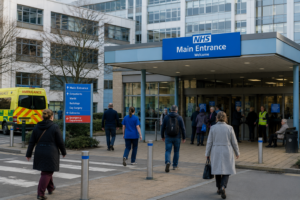
That’s what Julian Kelly, Deputy Chief Executive and Chief Finance Officer at NHSE managed to do, in his very frank report to the Board about ‘NHS productivity’.
We know he’s an artist with numbers. Now we know, he’s a sculptor of paragraphs.
Well, not quite. He nearly managed it. He did use the word ‘problem’ once, en-passant, in relation to the paucity of some data.
Nevertheless, it’s an amazing job, considering there are two P-words that are joined at the hip and becoming an increasing focus as we plod through the foothills of what is sure to be a steep climb to an election.
Kelly picks his way through the undergrowth of NHS numbers… but ‘problem’, he avoids. The other word, productivity… he can’t.
There is a ‘problem’ with productivity, that’s that. Cunning-Kelly invents the Kellyism, a terminological camouflage and calls it;
‘Implied’ productivity.
See… told ya’… wordsmith at work. Artful. Who knows what it means?
More important… who will admit they don’t know! Kelly gambles; we’ll sit… nod, wisely and few will attempt to read between the lines.
Machiavelli would be proud.
Across the UK productivity growth has been weak for a long time. Data from the ONS shows that the annual percentage change in output per-worker is undeniably fragile.
Interestingly, as Kelly points out;
‘… [before covid] the NHS typically delivered productivity growth at a faster pace than the rest of the public sector and the wider economy.’
But now; despite more money and more people working in the NHS, productivity remains stubbornly below pre-pandemic levels.
Having said that… I should point-out the NHS is providing record levels of healthcare with millions more GP appointments compared to pre-pandemic levels.
Something we all need to shout-out, more often… go and tell someone today, stick a sign on the office door. Make sure it’s referenced in every report and billet-doux.
NHS England are also being very productive. They are developing short, medium and long-term productivity plans with further details to follow… in the summer.
Kelly says;
‘… pre-pandemic, the NHS was ‘lean’ without enough capacity to absorb the [Covid] shock.’
Kellyism… he means; ten-years of austerity-funding crippled the NHS.
‘The population is older and sicker with more complexity, meaning longer lengths of stay.’
More? How about ‘Reduced flow’ through the system.
It’s a Kellyism… meaning;
‘… we can’t get vulnerable people home safely because social-care is knackered.’
As the report rolls on, there are more Kellyisms. Artful, silver tongued. Verbal veils to shield us from the ugly truth;
‘Lower staff engagement’.
That’s Kelly for… people are knackered, striking, sick, hacked-off, morale on the floor. Instead of lending a hand, they might show you the finger.
More staff, for sure but the newcomers are inexperienced, younger and many from overseas. Too many older and experienced people have gone. With them their knowledge, skills and learning legacy.
The final rhetorical flourish? A Kellyism to be proud of;
‘… [the NHS] was ‘significantly impacted by industrial action’.
He’s trying to tell us;
‘…strikes are a damned nuisance, point to industrial relations fault-lines and have screwed-us-up.’
So, what’s the up-shot of all this?
Did you see the the movie The Italian Job? With Micheal Caine? If you did, you’ll know what I mean when I say;
Kelly, for all his circumlocutory has… ‘blown the £!@@%^ doors off’ and tells us what the NHS is struggling with and the reasons why.
He’s told us, the NHSE Board, and anyone else who will listen, there are three problems.
The three S’s;
• Sicker people and longer length of stay.
• Social care can’t keep up hence system flows interrupted.
• Simply not enough capacity due to the lack of investment in systems, kit and buildings…
… none of which the NHS can fix. Only political-will, can do that.
It’s a very frank, report. Careful, thorough and is a cuppa-builder’s read. As a bonus, we have a new word. A new euphemism for problems that dare not speak their name…
… the Kellyism.
News and Comment from Roy Lilley
Contact Roy – please use this e-address roy.lilley@nhsmanagers.net
Reproduced at thetrainingnet.com by kind permission of Roy Lilley.
Related
Discover more from The Training Network
Subscribe to get the latest posts sent to your email.