At last there is some good news…
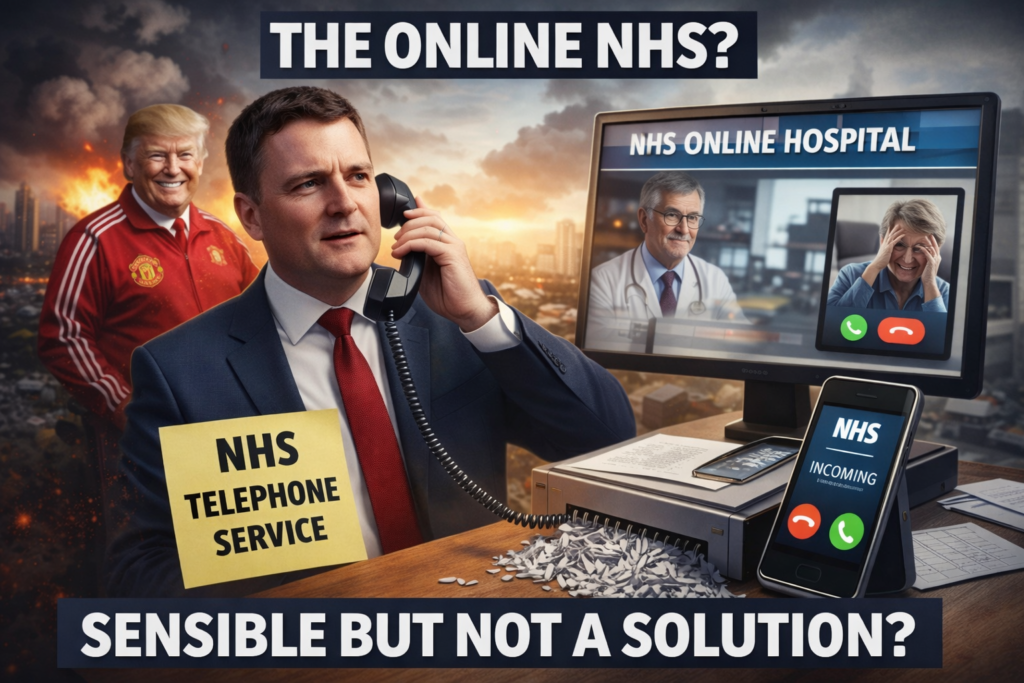
… as the world order is collapsing and Donald Trump is tipped as the new manager for Manchester United, I can confidently report…
… Wes Streeting has discovered the NHS has telephones.
He’s realised what the NHS realised a long time ago, a lot of what they do can be and is, done on the blower.
His announcement (I really should say re-announcement) of an online-hospital wheeze, prioritising menopause, prostate conditions and other long-term needs, is cleverly repackaged to sound as though it will boldly take us to the new frontiers of medicine, innovation and Dr Spock.
Actually; including general practice, hospital outpatient follow-ups, community services and advice lines, it’s a reasonable estimate that well over 100 million clinical, telephone-consultations are conducted each year.
GP appointments alone account for ~90 million.
In reality, shifting routine-care onto the phone pulls together what’s already happening.
Nothing new here. What is new is the attempt to badge it as a single national offer and scale it quickly, by 2027… 12 months… good luck.
As a direction of travel, it makes sense.
Patients save time, travel and frustration.
Clinicians can manage stable conditions more sensibly.
Demand smoothed rather than spiking through outpatient clinics.
At this point I’m trying not to use the word ‘but’ as I don’t want to sound negative, coz-I’m-not….
However… (see what I did)…
… if you lift the bonnet and look at the money, the claims about efficiency, they need to be treated with care.
Do the maths…
For a population of 100,000, outpatient activity typically costs around £20m a year.
With optimistic assumptions… a quarter of follow-ups suitable for digital or patient-initiated pathways, good clinical discipline and proper substitution rather than duplication…
… the net, cash-releasing saving is likely to be around £0.5m per 100,000 population, a year.
That’s after allowing for digital platforms, support staff, double-running, changes to consultant contracts and the stubborn reality that most hospital costs are nailed on, superglued and fixed.
Half a million per 100,000 is not nothing, but it’s not transformational.
For an average ICS, perhaps £5m a year, that’s around 0.2% of acute spend… easily wiped out by winter pressures, agency costs or diagnostic backlogs.
This is a flow and experience improvement, fair enough… not a fiscal reset.
Compare that with the cost of not fixing delayed discharge because Streeting still has no viable plan for social care.
The best estimates put the annual NHS cost of delayed discharge at around £2bn.
Spread across England’s population, that is roughly £3.5m per 100,000 population every year…
… that’s the price of failing to fix social care…
…around seven times larger than the best-case savings from the online hospital model.
Does that comparison matter? I think so…
… digital outpatients may reduce low-value follow-ups.
… broken social care blocks beds, cancels electives, backs up ambulances and destabilises the entire system.
One delayed-discharge ward costs more than the annual savings from virtualising a whole tranche of outpatient activity.
The management lesson comes from Eliyahu Goldratt and his fascinating management novel, The Goal (1984).
He writes;
‘Every system has a constraint (bottleneck). Improving other parts that aren’t the constraint yields little. So identify the biggest bottleneck … [delayed discharge beds]… and resolve that first…’
Hard to argue with that.
Telephone appointments save patient’s travel time, but with calls to line-up, extra admin, and follow-ups, the impact on waiting lists is likely modest at best.
There’s also a deeper structural problem. I mentioned it yesterday… stick it on yer office door, add it to yer email signature;
‘… nothing changes unless the tariff changes.’
Hospitals have high fixed overheads. You cannot ‘digitise’ those away. If activity falls but the tariff still rewards face-to-face events, trusts lose income faster than they lose costs.
Digital success becomes a financial failure.
For the online hospital to work at scale, the tariff has to move away from paying for appointments and towards paying for pathways and outcomes.
Pay for virtual care properly, not as a discounted version of real medicine.
No one talks about it because it’s too difficult…
… either, we fix the tariff and accept that some hospitals will shrink or even close, or we accept that hospitals will run at a loss.
Digital outpatient care won’t save us from that choice.
The online hospital is sensible, overdue and patient-friendly, but… not a solution to any NHS problems… doesn’t save real money, is only marginally more efficient.
In fact it just creates a shedload of new ones.
News and Comment from Roy Lilley
Contact Roy – please use this e-address roy.lilley@nhsmanagers.net
Reproduced at thetrainingnet.com by kind permission of Roy Lilley.
Related
Discover more from The Training Network
Subscribe to get the latest posts sent to your email.