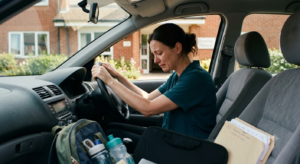
When The Duchess was around, she needed a good deal of maintenance and pit-stops to keep her going.
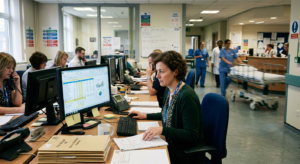
It was back-in-the-day of family practice. She was particularly attached to an experienced ‘lady doctor’ as she called her and actually looked forward to her visits to the local hospital…
… particularly when she’d ‘been seen’ by the military doctors and nurses who worked there.
Mum would come back from a visit saying she always felt she’d seen a ‘proper doctor’ or nurse. Mainly because of their ineffable politeness to an elderly lady…
… who always made sure she wore her RAF broach, that signalled to everyone, ‘that’s what she did in the war’…
… they’d always ask her about it…
… and in her words, ‘they looked like proper doctors and nurses’… in uniform, unlike NHS staff who were bundled in plastic and young doctors who, frankly, some who looked like they could be popping into the ward on the way home from a night-club.
Try and explain the intricacies of infection control to an ninty year old… don’t bother. Perception is everything.
The war years cast a deep shadow over her generation and now Starmer tells us it will cast its darkness over a new generation. He is too young to understand.
War is so easily spoken lightly of but so heavy when borne as a burden of the actuality.
The government’s defence review was published yesterday.
Full of ambition, the hope that technology will lift us into a safe new future and no means whatever of paying for it.
If we are obliged to fight a war and please pray to your god that we won’t, I wonder how ready our defence medical services are?
Since the mid ’90’s the MoD decided to close all the military hospitals and transfer secondary and specialist care of military personnel and veterans to the NHS.
Hence the Ministry of Defence Hospital Units in NHS hospitals… and the delight of The Duchess.
The MoD produced reports; ‘Options for Change’ and ‘Front Line First’, leading to reductions in military personnel…
… as of this January, to a new low of 136,000 (less than a couple of full houses at Wembley stadium) and, reductions in Defence Medical Services.
Following the Gulf War the House of Commons Defence Committee said the cuts had seriously impaired the UK’s ability to provide medical support to the front-line.
Restructuring the UK’s military medical services in the 1990s, driven by cost-savings, closures of military hospitals and reductions in trained medical personnel…
… had significant implications for the care of service members during and after deployments and I would guess, put us nowhere near where we should be if Starmer is going to drag us into a war.
HMG is very chary about the numbers of military medics…
… but it is a safe bet the general reduction impacts the DMS proportionally…
… I’d guess, no more than; 7,000… general practitioners, nurses, surgeons, dentists, and combat medical technicians.
They train at the Defence Medical Academy at Whittington in Staffordshire… focusing on scenarios way-beyond standard first-aid, to prepare for combat-related medical situations with exercises in Kenya.
The integration of military, medical personnel into the NHS ensures continuous clinical engagement, but the challenges, looking after my old Mum, may not sufficiently prepare them for the unique challenges of wartime medical care.
The army has faced challenges in maintaining adequate blood supplies for potential high-casualty scenarios, prompting initiatives to encourage regular blood donations among soldiers.
This says there’s a need for a more resilient medical logistics infrastructure.
There are obvious concerns about the overall operational readiness of the military which, in fairness is underlined in yesterday’s review.
It describes military medical services:
- fragmented and underfunded;
- neglected;
- notes the operational relationship with the NHS has been de-prioritised;
- a need to rebuild medical capacity and capability;
- calls for organisational reform within Defence…
…ensuring that medical services are adequately structured and resourced to meet current and future challenges.
Sounds exactly like the NHS.
It seems to me as much as the government needs our services to be ready to defend our nation…
… we need to be more ready to defend our services from government.
News and Comment from Roy Lilley
Contact Roy – please use this e-address roy.lilley@nhsmanagers.net
Reproduced at thetrainingnet.com by kind permission of Roy Lilley.
Military Medical Services,
NHS and Veterans,
Defence Policy UK,
Elderly Healthcare,
Post-War Generations.
Related
Discover more from The Training Network
Subscribe to get the latest posts sent to your email.