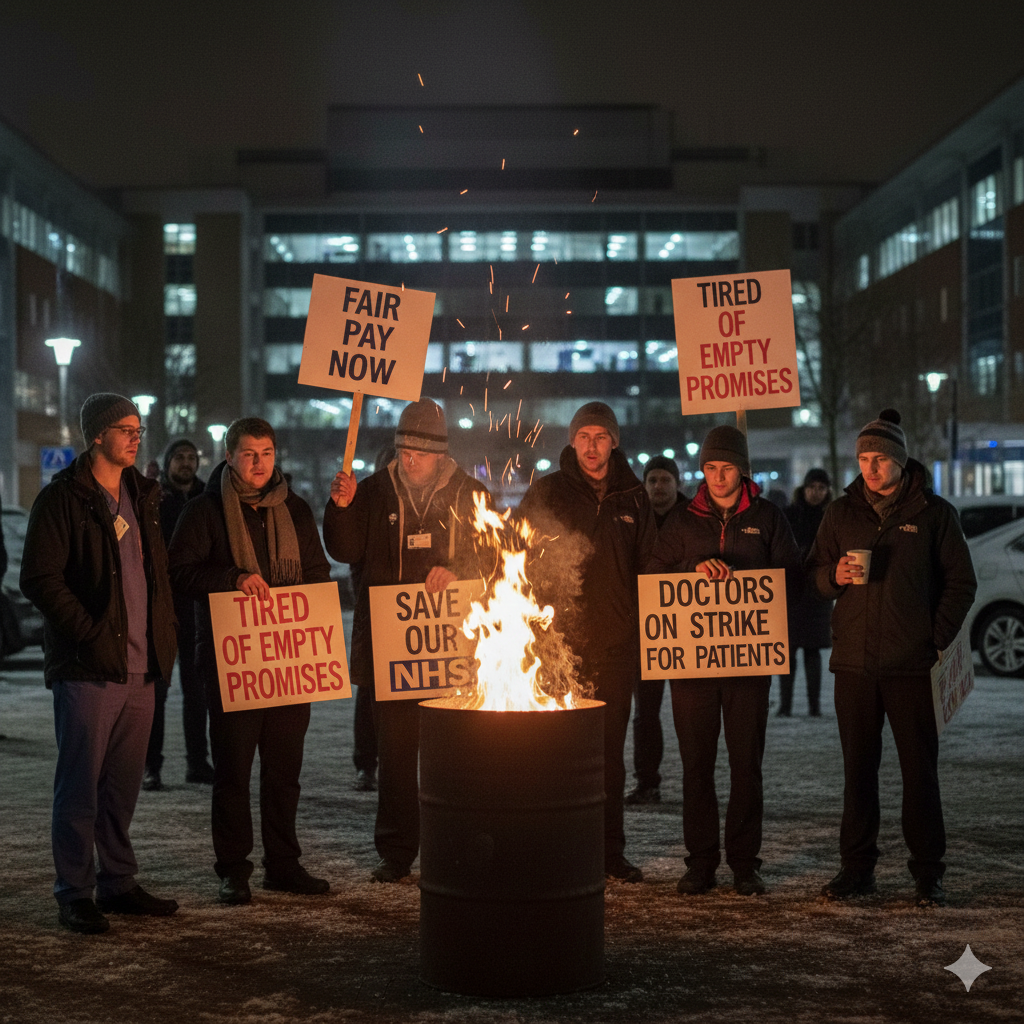
The question of the moment…
One for Mystic Meg, or Paddy Power.
In the light of Streeting’s latest, beefed-up offer, what are the odds on the BMA resident doctors voting to stall their upcoming strikes.
Let’s have a look.
The strikes have always centred on pay. From the outset, the dispute has been driven by real-terms pay erosion over years…
… which doctors view as a fundamental grievance threatening the sustainability of their profession, but…
… the government’s latest offer contains no pay increase…
… focusing instead on non-pay concessions such as a significant increase in specialty training posts, funded exams and legislative guarantees prioritising UK graduates.
All meaningful improvements in career progression but fail to address the core issue that prompted the strikes in the first place and have kept them fuelled.
Accepting this deal without any pay restoration would represent a clear political and substantive victory for Streeting and a crushing defeat for the BMA leadership.
It would consolidate Streeting as a leadership candidate to replace the Charmer and on the other side of the coin, set the new radical BMA back years…
… probably triggering the resignation of the present leadership.
It is for this reason the union leadership has chosen to stay neutral, offering no recommendation to members on the proposed deal…
… a significant strategic posture…
… by remaining neutral, the leadership avoids direct responsibility for the outcome.
If members reject the offer, the leadership is shielded from blame.
If members accept the offer, they retain plausible deniability in the face of future resentment.
The choice to stay neutral is a protective measure, recognising that the majority of members are unlikely to endorse a non-pay offer, yet allowing the leadership to maintain credibility in a highly charged political environment.
Member perception, rather than rational assessment alone, is now central.
The deal can be interpreted in two ways…
… as a strategic win, demonstrating that the government ‘blinked’ under pressure and the BMA extracted concessions, or…
… as a symbolic defeat, since none of the financial demands driving the dispute have been met.
This creates a psychological dimension in which pride, ego and momentum become as important as the material terms of the deal.
Hard-core members are likely to view any acceptance without pay as a betrayal of the central purpose of the strikes. Souring internal union dynamics. Undermining future cohesion.
Another forgotten factor influencing the vote is financial pressure on striking doctors.
Resident doctors do not receive strike pay. While there is a welfare fund, it only partially offsets lost earnings.
For some members, those early in training or later, with financial obligations, this may create a nudge to accept compromise, but unlikely to override the principle of pay for the majority.
Public attitudes, often a lever in industrial disputes, appear to matter diddly-squat to striking doctors.
They’re focused on principles rather than optics.
They’ll be thinking, we’ve pushed this far up the hill. Starting again would require recreating a momentum we may not achieve… so press on.
I’m sorry to say, I can’t see Streeting’s offer is likely to end the strikes… I hope to be proved wrong.
The absence of any pay restoration, or a pathway to it, means it fails to meet the fundamental demands driving industrial action.
Acceptance would give Streeting a short-term political victory but…
… it would likely leave a smouldering resentment among BMA members and a weakened leadership. They’d have to quit… which might suit non-striking doctors.
Wrap the offer, leadership neutrality and member psychology in Xmas paper and it’s still not a gift for Streeting.
As much as I don’t want to see it; it all points to a rejection and further negotiations as the most probable outcome…
… with long-term implications for union cohesion, trust in leadership and the soured political relationship between the BMA and the government, antagonised by Streeting’s rhetoric and the obvious fact…
… he’ll be looking at ‘getting his own back’ on the BMA.
His Wednesday night’s speech in the Commons about ‘the BMA dousing the NHS in petrol’ was the most gobsmackingly stupid, antagonising, immature, thoughtless and badly sighted speech I’ve heard in years…
… in fact, given the precarious moment in negotiations, make that… I’ve ever heard.
This dispute is less about concrete terms and more about symbolic victories, internal politics and the projection of strength.
Resolution will hinge as much on perception and framing as on material concessions.
Without movement on pay, the strikes are unfinished business.
Meantime NHSE is busy cranking up the ante, with horror messages about super flu.
The BMA and Streeting face a precarious path…
… navigating their various supporter expectations, internal party and union cohesion and external political and public pressures.
This ain’t over.
News and Comment from Roy Lilley
Contact Roy – please use this e-address roy.lilley@nhsmanagers.net
Reproduced at thetrainingnet.com by kind permission of Roy Lilley.
Related
Discover more from The Training Network
Subscribe to get the latest posts sent to your email.