Move the power…
NHS devolution and regional power
The discussion around NHS devolution and regional power is vital for understanding the future of healthcare in the UK.
NHS devolution and regional power are crucial for enabling local leaders to make decisions that directly impact their communities.
NHS Devolution and Regional Power: A Pathway to Localised Healthcare?
Not just the payroll…
It’s my new slogan… I’m rather pleased with myself! I might open a PR company.
The success of NHS devolution and regional power hinges on collaboration among local stakeholders.
There’s more…
… the NHS is short of beds, nurses, scanners, social care and money. It’s not short of train tickets.
Go on, admit it… that’s good! 😊
NHSE spent nearly £10m on business travel in 2024–25, including £7.75m on rail journeys.
Achieving NHS devolution and regional power may require changes in legislation and policy at the national level.
The accounts do not tell us where everyone was going but, somewhere inside that number, is the cost of carrying the management of the NHS between London and Leeds.
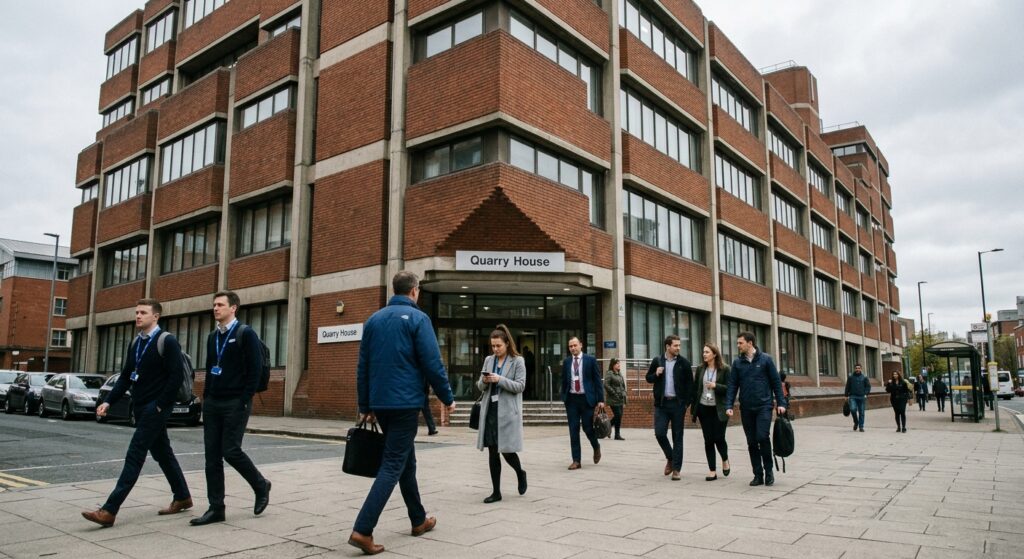
Quarry House, the NHS’s imposing northern headquarters…about 200 miles from Whitehall.
(Good morning Leeds)
From atop a mountain of ignorance I’d guess is, the London-Leeds shuttle could be costing around £1.4m a year in fares, local travel, subsistence and accommodation.
It is only a guess. NHSE are very coy about the actualité.
Add to that the value of thousands of hours spent getting to stations, waiting on platforms and sitting on trains. The true cost may be nearer £3m.
As for the people having to do it… early starts, late nights, unreliable time tables…
…LNER train performance fluctuated between ~71% and 79% last year…
… stuff-it. Find another job. I would.
In money and NHS terms, it’s loose change.
Through NHS devolution and regional power, we can ensure that services are tailored to the specific needs of different regions.
That is not the point.
Ultimately, NHS devolution and regional power should lead to improved health outcomes for all citizens.
The point is that in a disappointing act of Silly-Boy-Style performative government, Health Secretary Yvette Cooper (who seems unaware of Teams and Zoom) has asked officials to develop plans for a new Health and Social Care North based at Quarry House…
This transition towards NHS devolution and regional power is essential for reducing health inequalities.
… ministers would work from Leeds and the department’s operations outside London would be strengthened.
We are told this will bring decision-making closer to communities and is part of Andy Burnham’s wider devolution and locality programme.
It sounds good. There is just one snag.
Leeds is not local to Cornwall, Kent, Norfolk, Birmingham, Newcastle or most of the rest of England.
Moving a centralised bureaucracy 200 miles north does not make it less centralised.
Quarry House is not new. NHS management and Department of Health staff have worked there since 1993…
…482 NHS staff and 40 Estates people relocated to Leeds on permanent transfer terms. £11.76 million was paid in relocation expenses.
… a government smoke-and-mirrors review estimated annual savings of £10.1m, at 1993–94 prices, compared with locating those staff in London.
So, there might be a good case for moving more jobs north? Dunno. Maybe…
- Office costs may be lower.
- Recruitment may be easier.
- The civil service becomes less London-centric.
- Ministers might hear different voices and see more of the country they govern.
All worthwhile, but…
Ensuring that NHS devolution and regional power are effective is vital for the sustainability of our healthcare system.
… let’s not confuse the relocation of civil servants, turning them into train-spotters, with the devolution of authority.
Devolution means giving regions the power to decide, the budgets to act and the freedom to organise services around their populations.
It means fewer decisions travelling upwards to the centre. It should mean fewer officials travelling between centres.
The danger is that DH++North simply creates another national headquarters; more offices, another leadership structure, duplicated meetings and…
… an even busier railway line.
We could end-up with Whitehall setting the policy, Leeds running the performance machinery and everyone else waiting for permission… and a train.
By embracing NHS devolution and regional power, we can empower local authorities to act more effectively.
This is not Burnhamism. His instincts are quite the opposite. His experience in Greater Manchester taught him that health cannot be separated from housing, transport, employment and social care.
Local involvement through NHS devolution and regional power can drive more innovative solutions to health challenges.
Those connections are made in places, not departments.
The real test of DH++N is not how many desks are filled at Quarry House. It is how many decisions Quarry House stops making and Regions make, instead…
- Will regional leaders control workforce planning?
- Will they be able to move money between hospitals, community services, primary care and social care?
- Will they control capital?
- Will they be permitted to design services without repeatedly seeking approval from Londeeds?
Advocating for NHS devolution and regional power can lead to a more responsive health service.
If not, DH++N risks becoming an expensive symbol of devolution rather than devolution itself.
The £1.4m estimated travel bill is not a scandal. A national service needs people to meet, visit and occasionally travel.
It is crucial that NHS devolution and regional power are implemented effectively to maximise their potential benefits.
The scandal would be building two national centres while continuing to weaken regional management.
By all means move jobs to Leeds. Move ministers there. Move teams there. Save on London property and spread opportunity beyond the capital, but…
… do not stop there.
The objective cannot be to move the command-and-control system north.
Only through NHS devolution and regional power can we truly address the unique healthcare needs of diverse populations.
It must be to dismantle it. In the North and in Whitehall.
Stop moving managers.
Start moving the power.
News and Comment from Roy Lilley
Contact Roy – please use this e-address roy.lilley@nhsmanagers.net
Reproduced at thetrainingnet.com by kind permission of Roy Lilley.
Related
Discover more from The Training Network
Subscribe to get the latest posts sent to your email.