The NHS does like a catch-phrase.
Remember; no ‘decision about me without me’…
That sounded good. I don’t think we ever did it.
There’s a new one… ‘care closer to home’.
It’s got a nice ring to it. But… whose home?
If it’s nearer to me… it might be further from you. One person’s convenience can be another’s inconvenience.
How does the NHS decide where to put its ‘closer to home’ services?
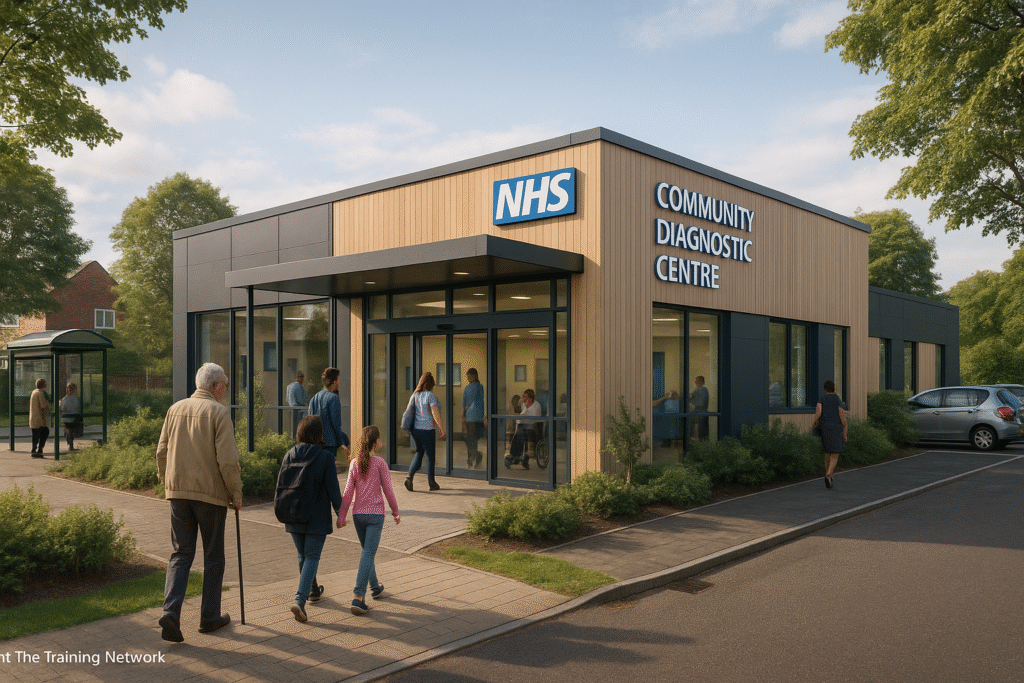
Historically, it’s been about inherited estates, political promises or the availability of willing providers. We see it with community diagnostic services. Just under half are on, or in, existing NHS estates.
It solves problems for NHS managers; planning issues, car-parking, mainly on bus routes… everyone knows where the hospital is…
… but not for NHS patients, who are no better off.
The NHS is a public service and should be safe, clean and accessible. It’s not so different for supermarkets.
Accessible means convenient and of principal importance to the likes of Tesco’s and all the rest.
They don’t open a store because a minister says so… or their Board, for that matter.
They use hard science, based on something called isochrones…
… measurements of time-over-distance. Maps of:
- how far people can travel in 5, 10, 15 minutes;
- population density;
- spending power;
- traffic flows; and
- competitive presence.
They know exactly how many people can reach a store. How often and with what disposable income.
They model it to the minute and the pound.
Tesco won’t open a store if it takes more than 12 minutes for enough customers to get there. The NHS, by contrast, might open a diagnostic hub on a redundant chunk of estate on the edge of town, even if the buses don’t run after 6pm.
If closer-to-home is to mean anything, the NHS needs to borrow a page from retail science…
… not about sticking pins in a map. It’s about isochrones, footfall, real accessibility and the lived experience of patients and carers.
If closer-to-home means convenient, easy and fitting well with our needs… there’s a place that most of us are within one kilometre of…
… it’s called a GP practice.
Before we spend millions on kit we can’t afford, to be worked in by staff we don’t have, we need to reframe this whole policy; the ROI doesn’t stack-up and ‘closer’ is meaningless.
We should;
Digitise first.
- Default to remote triage,
- remote follow-up and
- remote reporting where clinically safe.
- Keep physical visits for examinations and procedures that must be in person.
- Set targets by speciality in primary and secondary care…
… this will create the headroom for demand from people who need the intimacy and support of personal contact.
Upgrade only the ‘right’ community sites.
Use retail-style methods:
- isochrones,
- real travel-times by mode and time-of-day,
- deprivation,
- demand curves
…and pick some surgeries, pharmacies, health centres to host and ‘capture’ activity such as:
- bloods,
- ECG,
- plain film,
- scans, using store and forward techniques for interpretation,
- ambulatory diagnostics…
… not all locations. Where the building, parking, or workforce won’t support it, don’t shoehorn it.
Guarantee the journey for the minority who need it.
For people who meet Non-Emergency Patient Transport Services criteria or where access barriers would otherwise cause problems, offer a simple, beefed-up transport guarantee with; block-booked shuttles, or taxi contracts.
Backstop with a refreshed Healthcare Travel Costs Scheme for eligible patients’ out-of-pocket travel.
Make services clean, cheerful, reliable and as easy to book as an Uber… use the NHS App.
Measure what matters.
Publish three KPIs per place:
- median door-to-door time, to test or treatment by IMD decile;
- did-not-attend rates;
- per-test-result cost, including transport.
If ‘closer to home’ doesn’t improve those three, stop doing it and the ‘closer to home’ promise is meaningless.
Understand that;
convenience = time + reliability,
not just distance and…
… it leverages the digital-remote shift already embedded in both general practice and diagnostics. Instead of fighting it with hugely expensive alternative patient offerings we know we’ll struggle to staff and pay for.
It also has the benefit of containing capital spend by selectively upgrading only buildings that pass a volume-and-access test, while protecting equity through a transport guarantee.
Alongside this, invest, develop, grow and up-skill community teams and services.
There is a new row brewing about Labour bringing back a version of PFI to fund new community hubs. Forget it, by the time they are through planning and built, technology will have made them redundant.
Think about this; if you can’t visit a Tesco, they bring it to you. Can the NHS think like that?
Take the NHS to the people?
For a glimpse of the future look at the handheld Butterfly iQ ultrasound. It’s a powerful, low-cost, portable diagnostic that can be taken into community settings and people’s homes.
Near-patient blood testing is racing ahead, along with lab-on-a-chip technology.
The iPhone used as a portable diagnostic gadget used by nurses to detect or rule out throat cancer. Another iPhone attachment performs wavefront aberrometry.
The NHS must shift from bricks to clicks and the meaningless, ‘closer to home’.
‘In the home’ is a whole new dimension.
News and Comment from Roy Lilley
Contact Roy – please use this e-address roy.lilley@nhsmanagers.net
Reproduced at thetrainingnet.com by kind permission of Roy Lilley.
Related
Discover more from The Training Network
Subscribe to get the latest posts sent to your email.