Jumping Jack flash (Alan Milburn) has been busy, telling the press;
‘I am delighted to be appointed to this role [on the DH+ board]. I am confident this government has the right plans in place to transform the health service and the health of the nation.’
It’s a curious thing to say.
If HMG has plans in place ‘to transform the health service’… what do we need the advice of a former secretary of state from twenty years ago, for?
I can see it’s difficult for the glitterati in the DH+ to get their heads around the difference between reform and modernisation…
… and I can see how seductive the power of words such as; personalised preventative and predictive care, may be… but…
… for the rest of us, in the real world of ambulance spotting and waiting list bingo, we are left wondering how all that will help us to help…
… a GP with a patient with depression, one of yer kids with tonsillitis, yer grandad with rheumatoid arthritis or the bloke you work with, with bowel cancer?
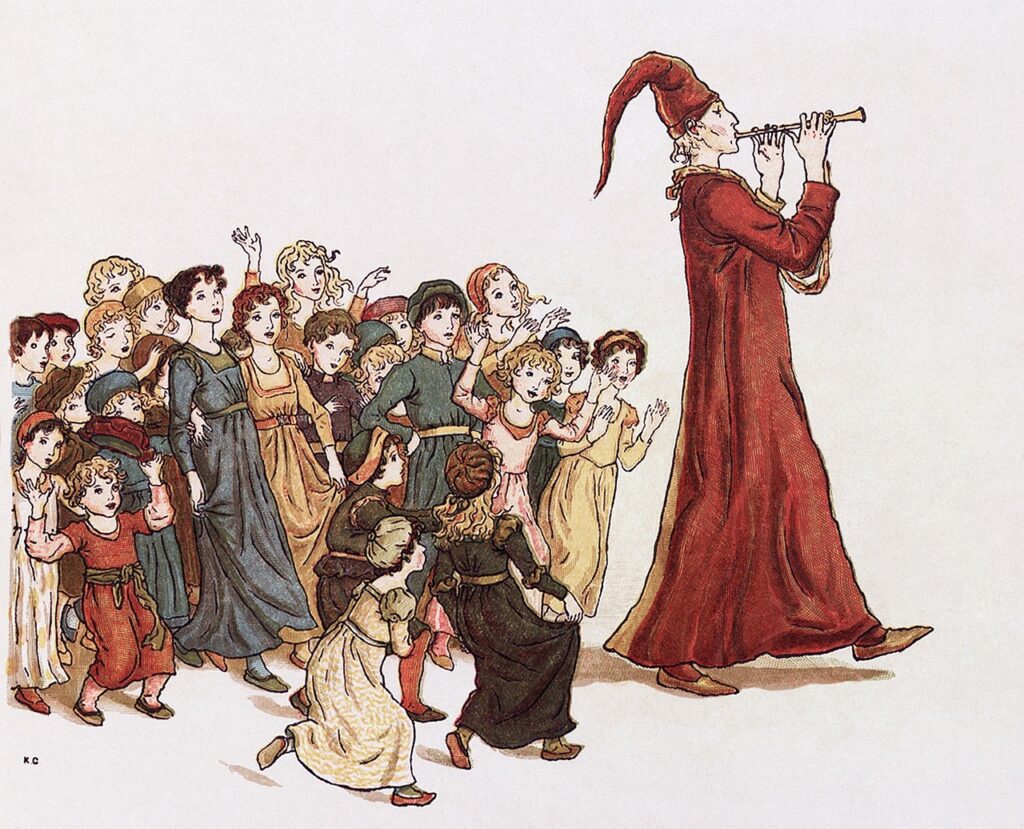
I fear someone, somewhere has pulled off the shelf, their copy of that great management tome, written by the German polymath Johann Wolfgang von Goethe, entitled; der Rattenfänger von Hameln…
… aka, The Pied Piper of Hamelin… in which…
… our principle character, for reasons of schadenfreude, played a magic flute and lured the town’s children to a beautiful land and are never seen again.
Folklore? Well, there is a report of a 14th-century eyewitness account of the event!
I smell a rat.
I fear we might be poised to witness it again. Jumping-Jack-Flash will lure the minds of the eager-to-impress into believing another huge upheaval is required to ‘reform’ the NHS and lure them into fairyland…
… when a rationalisation of the number of ICBs and a few quid invested in modernisation would do the trick.
Whilst I do not go back quite as far as the 14th century, I have been around for long enough to know the damage reorganisations do and how little they produce.
I can tell you Jumping-Jack’s primary care groups, with;
- Setup and Administrative Costs, hiring staff, creating new governance structures, and organising support systems.
- Operational Costs, including ongoing operational funding, salaries for clinical and managerial staff, overhead costs, and expenses related to data systems and quality assurance.
- Training and Development, for managers to understand and operate within the PCG framework.
… cost millions.
Some of the costs were absorbed by reallocating existing funds.
But…
… the full financial impact turned into a tsunami when it was realised PCGs were too small and along came the cost of integration efforts to evolve them into Primary Care Trusts, in 2002.
They were eventually dumped, with no improvements in quality and no savings in operating costs.
This was just one of many reorganisations, reform re-dis-organisations none of which have worked, and believe me I’ve seen plenty.
The only formation that really did the job was a regional structure of about ten organisations, that included local authorities, education, police, housing and all the usual NHS people.
Big enough for the centre to have line of sight to what’s what but operationally manageable on the ground.
They were called Regional Health Authorities. They struggled for lack of timely information and financial controls, all of which, today, is available on a lap-top.
If I could press a button, yes, I’d go back there, and I see no reason not to transition ICBs into them. Cheaper and quicker.
The upheaval of reform is the last thing the NHS needs right now.
People forget there is not an auxiliary group of ‘reformers’ that can turn-up and ‘do reform’. There are only the people we have, who have their hands full with the day job.
Changing structures comes on top of the day job.
Changing structures would be the same as demolishing Tower Bridge and building a new one and at the same time, keep the traffic flowing and raising it up and down to let the ships through.
All the NHS needs is a period of calm, some decent investment in IT and data analysis and to remember, before Covid it was rated as the best health service in the world for its strengths in care-process, equity, and efficiency.
If you want to get it back there, nurture it, don’t demolish it.
News and Comment from Roy Lilley
Contact Roy – please use this e-address roy.lilley@nhsmanagers.net
Reproduced at thetrainingnet.com by kind permission of Roy Lilley.
Related
Discover more from The Training Network
Subscribe to get the latest posts sent to your email.