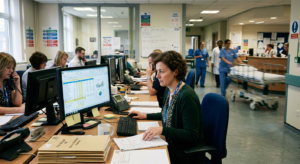
The BBC is really pushing their latest Panorama.
It’s called ‘Fixing the NHS, what will it take’. You can watch it on iPlayer, the link is here.
It is a competent piece of journalism, by an experienced BBC pro’.
Is it any good? Worth watching?
Well… if it were a cupboard, it would be like yer granny’s larder; everything you need, easy to find, labelled, neat and tidy.
Like an irritating neighbour’s garage; with all the spanners and hammers and screwdrivers hanging neatly on a board. Lines drawn around their edges to tell you if a vital tool is missing.
Absolutely nothing was missing in this programme. Neat, tidy and as innocent as a choirboy at evensong. As balanced as a set of laboratory scales.
A bit of the good… a diagnostic hub, the evangelical staff and a grateful customer.
A bit of the bad, pictures of queuing ambulances, shots of patients, with their faces obscured (BBC guidelines), marooned on trolleys in corridors.
Andrew Dilnot popped up. He said what he said years ago; you can’t fix the NHS without fixing social care…
… no one listened then and even though he is now ‘Sir Andrew’, still no one is listening.
Our great leader made a cameo appearance. He could have been the regional chairman of the flat-earth society… but less convincing. He said, dismantling the NHS and trying to deal with waiting lists and a ten year plan all at once would not distract the NHS.
There was a hint that he intended to take NHS money to fund social care.
I noticed his tie was crooked. It never usually, is. Perhaps a sign? A message? An sartorial haruspex, he’s losing it?
Ok… let’s get to grips with this. I want to say the programme was rubbish… but I can’t.
It’s a programme no one can really complain about but it didn’t tell us anything we didn’t already know. There’s good stuff and bad going on. That’s the problem with the BBC.
They’re stuck.
Much like the NHS, that has no choice and must deal with everyone who wanders through the front door, in the name of equity…
… the BBC struggles in the name of balance. Meaning, for everyone they find who will criticise the NHS, they have to find someone who praises it.
Like granola without the nuts. No gritty bits.
The NHS can no-more say to a clinically obese, couch potato; ‘don’t come waddling to us with your self inflicted diabetes, COPD, blood pressure, depression and haemorrhoids’…
… than the BBC can say to the secretary of state; you’ve got no more idea how to run the NHS than a lollipop man.
To be fair, the programme did its best.
An example of machine-learned diagnostics that had been invented and fettled by a doctor but didn’t seem available anywhere but where he worked…
… and a pitiful sequence featuring the kindest care assistant you’ll ever meet, on his hands and knees trying to connect with a client with learning disabilities.
It was all there. Passion and hope, despair and hopelessness. The technology and the lack of it and…
… I have to say, there was one ray of sunshine…
… a GP who had ignored the targets, collected data and used it to prevent people from getting sick and ending up in hospital.
The Steel City Practice in Sheffield. Dr Krishna Kasaraneni; Seven minutes into the programme.
Yes, yes, yes. As vanilla as was the rest of the programme, this was the espresso moment.
The use of data, innovation, initiative, rebellion…
… what can be achieved when bright, committed people are left to get on and use their skill and ingenuity, to focus on wellness.
Have I been too harsh about the programme?
Well, you’ll have to watch it to find out, (that’s my cunning plan), but I know this…
… if you believe what I believe and think like I think…
… you’re gonna love Dr Kasaraneni.
News and Comment from Roy Lilley
Contact Roy – please use this e-address roy.lilley@nhsmanagers.net
Reproduced at thetrainingnet.com by kind permission of Roy Lilley.
Related
Discover more from The Training Network
Subscribe to get the latest posts sent to your email.