Don’t tell me you you don’t enjoy one, now and again.
Perhaps you enjoy them now and again and again and again!
Crispy sugar on the outside, the light spongy dough and then, the jammy bit in the middle.
Apparently, Morrisons’ have the best jam doughnuts!
Oh, the middle bit!
It’s always the middle bit.
A cheese and pickle sandwich. Crusty, fresh bread, a generous smear of butter from Gloucestershire. Cheese straight from Cheddar Gorge in Somerset and a dollop of Branston with its umami depth of flavour, or mustard Piccalilli… take your pick.
Whatever… bite into it, the best bit is in the middle.
Reading a book?
Romp through the opening pages. Set the scene, establish the theme. In the final pages, unravel the tangle.
In between, the middle bit.
The bit where we identify with the characters. Get thrown off the scent. Where the book comes to life. The thrill of turning the pages. The pace, the tempo, the colour and texture the writer brings to the story.
The middle bit, always the best bit.
On the sofa, the feet-tucked-up-under-you, bit. The, just-a-couple-more-pages before switching out the lights, bit.
The middle bit is always the best bit.
Middle age? A time of crisis? No. The middle bit of life is the best bit. Believe me, I’ve been there and back again.
By middle age, people have reached a level of expertise, seniority, and financial security in their careers. Long-term friendships have weathered the test of time. Family ties are stronger. There’s less peer pressure to ‘fit-in’ and ‘follow the crowd’.
It’s a time to ‘be yourself’. Understand your values, know where to set the fulcrum point between work and life. By the middle bit you will know who you are, what you’ll stand for and what you’ll stand against.
The middle bit… always the best bit.
Not, if you listen to the management gurus. They’ll tell you, middle-management has no place in modern, flat, organisations.
They ‘clutter the place up’. Confuse everyone.
The gurus are wrong. The argument for middle management is stronger today than ever.
Organisations need a rudder, it comes from leadership with a clear vision.
Organisations need energy, it’s to be found at the sharp end of delivery, where reputations can be hard won and lost in a moment’s carelessness.
Organisations need an engine, to power its plans and it is to be found in the middle.
Middle management.
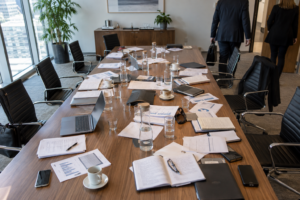
Middle managers are the bridge between strategy and execution. They are the translators, turning the hope and plans of the Board into doable, understandable tasks for the frontline.
They’re well placed to open communication… be the conduit, back and forth.
They will know the organisation, probably better than most. They’ll know the weak spots, the high spots. The innovators and the time wasters. They are the bit in the middle, which is always the best bit.
They oversee, mentor and support employees. The middle is where the productivity comes from.
Middle managers can streamline processes, optimise resource allocation, solve problems. They know where savings are low-hanging fruit and where fallow-land needs tending and tilling.
They are organisers, the makers-of-stuff-happening. The ring-masters, the knowledge keepers and the light shiners. They can make better decisions than anyone in the organisation because they are submerged in the organisation. Marinated.
They are the early warning devices. Agile. The un-bottlers of bottlenecks.
However…
… the middle can sometimes be a precarious place. The middle gets squeezed. The jam plops out, the pickle oozes around the edges.
The middle manager, pinched between practicality and delivery. Rammed between resource and reality. Torn between targets and truth.
The difference between delivering lofty policy and the grind of making it happen.
The predicament so beautifully captured in Will Dolan’s short film, ‘Yeah, I’m fine’… sixty five seconds of the most powerful picture-making you will ever watch. Subtle, skilful message-making.
See it. See yourself. See others around you. See where you work, used to work and places that didn’t work.
Magic movie making in just over a minute.
So it is; this Monday, by the power vested in me, by absolutely no one… today, I declare it is Middle Management Day.
There are a few backs that need patting, go and find them.
-oOo-
Thanks to Firewood Pictures for letting me use one of their amazing films.
News and Comment from Roy Lilley
Contact Roy – please use this e-address roy.lilley@nhsmanagers.net
Reproduced at thetrainingnet.com by kind permission of Roy Lilley.
Related
Discover more from The Training Network
Subscribe to get the latest posts sent to your email.