Young girls go to Primark. Young professionals mooch around Zara or Massimo Dutti. Elegant ladies of a certain age go to Marks and Sparks.
Yes… there’ll be some cross-over but fundamentally, that’s the way it is.
The market is segmented by very smart retailers who know their stuff, their customers, how to create the right ambiance in the stores and get the adverts pin-point targeted.
You won’t find many old-geezers in places like that.
Unlike the NHS…
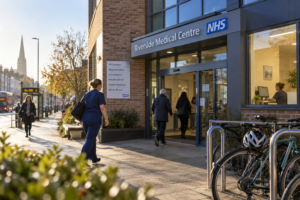
… where, in the GP’s waiting room you’ll find old geezers sitting alongside the Marks and Sparkle ladies, the suited and booted young professionals and the teenagers scrolling their phones.
Apparently, this is all going to stop.
Dr Claire Fuller, the grande-dame of all matters primary care and now part of the NHSE ‘transition executive’ gang, has said so…
… not that you’d know… unless you have mastered the pretentious language of the faux-guru.
Fuller said;
‘The…“relational continuity” of care had suffered in recent years for the estimated 15 million people with long-term conditions.’
It’s gobbledygook, designed to continue the conspiracy between the professions and the laity. The perfumed and the unwashed.
It means;
‘… the ongoing and continuous relationship between a patient and their healthcare provider(s). It emphasises the importance of a long-term, established connection for effective and high-quality care…’
Which, for me, means… family practice.
Except… it doesn’t.
Fuller says;
‘… we’ve moved away from the 1948 [model] and have realised now that not one size fits all… The good news is that at the heart of that is a universal primary care offer [and] an increased primary care offer.’
What’s an ‘offer’? Dunno. Management blah. I’d guess it’s what ‘they’ think ‘we’ should get.
Fuller carefully avoids the word ‘segmentation’…
… but that’s what she’s getting to.
The rarified heights of Milburn Towers has made her dizzy.
And…
… I sort of agree with her. But, there’s a but.
If you look at the numbers and the causes of the NHS’s predicament, largely, it comes down to the under nine’s and the +65’s clogging up hospital beds and A&E, and people with longterm conditions who become unstable.
The kids need to be looked after better, by health visitors, mums and dads need to be somehow, better supported…
… and that says family practice…
… old geezers like me, and the geezereenes, better supported and kept out of hospital by community nursing and social care at the heart of which is…
… family practice, and…
… people with long term conditions are usually experts in their condition but do need regular contact and help, the best place for which is…
…family practice.
What’s the alternative?
Stream-out eldercare… to where? Hospital?
The supermarket? The libraries are warm in the winter.
For most of us the GP isn’t far away.
Look after the kids someplace else? Schools? They have their own problems.
For most families, the GP isn’t far away.
Place-based care? Where’s the place that’s in the place, that is the right place?
The best place… the GP practice.
How best to get a feel for how grandad is doing, his grandkids are doing, mum and dad are doing… how the family is doing?
How about family practice.
The latest wheeze, ‘neighbourhood services’, that focus on the family…
… says to me; family practice.
The working well, the youngsters, the busy people… a doc-in-yer-pocket. Phone consults will work well enough. Digital-first. We know that… not new.
It’s in the existing long-term plan.
We also know; when the wheels come off, when happenstance takes over… there is a patient and their circumstances, their hinterland, their circle and their family.
That sounds like family practice to me.
And, what about the young-geezers… aged 25–40. Life expectancy hasn’t improved since the early 80s. They’re now 2.5 times more likely to die than women of the same age. Suicide, drugs and alcohol… (see graph below)
That sounds like family practice to me.
When there is a patient about to leave, with their hand on the consulting room door handle…
… the wistful look is saying ‘there’s something else’. The body language is trying to find the words and the eye contact is screaming-out for help…
… that sounds like family practice to me.
Claire Fuller says;
‘… there are some real tragedies of stories of particularly young people whose diagnosis is missed because they are accessing care through multiple sources…’
She’s right and…
… that sounds like family practice to me.
Don’t reform it. Reassure it, rebuild it, restore it, renovate it, remake it, reconstruct it, refurbish it, recondition it. Don’t replace it.
Don’t segment it.
Don’t kill it off with management speak.
News and Comment from Roy Lilley
Contact Roy – please use this e-address roy.lilley@nhsmanagers.net
Reproduced at thetrainingnet.com by kind permission of Roy Lilley.
Family Practice,
Primary Care Reform,
Healthcare Segmentation,
NHS Continuity,
Community Healthcare.
Related
Discover more from The Training Network
Subscribe to get the latest posts sent to your email.