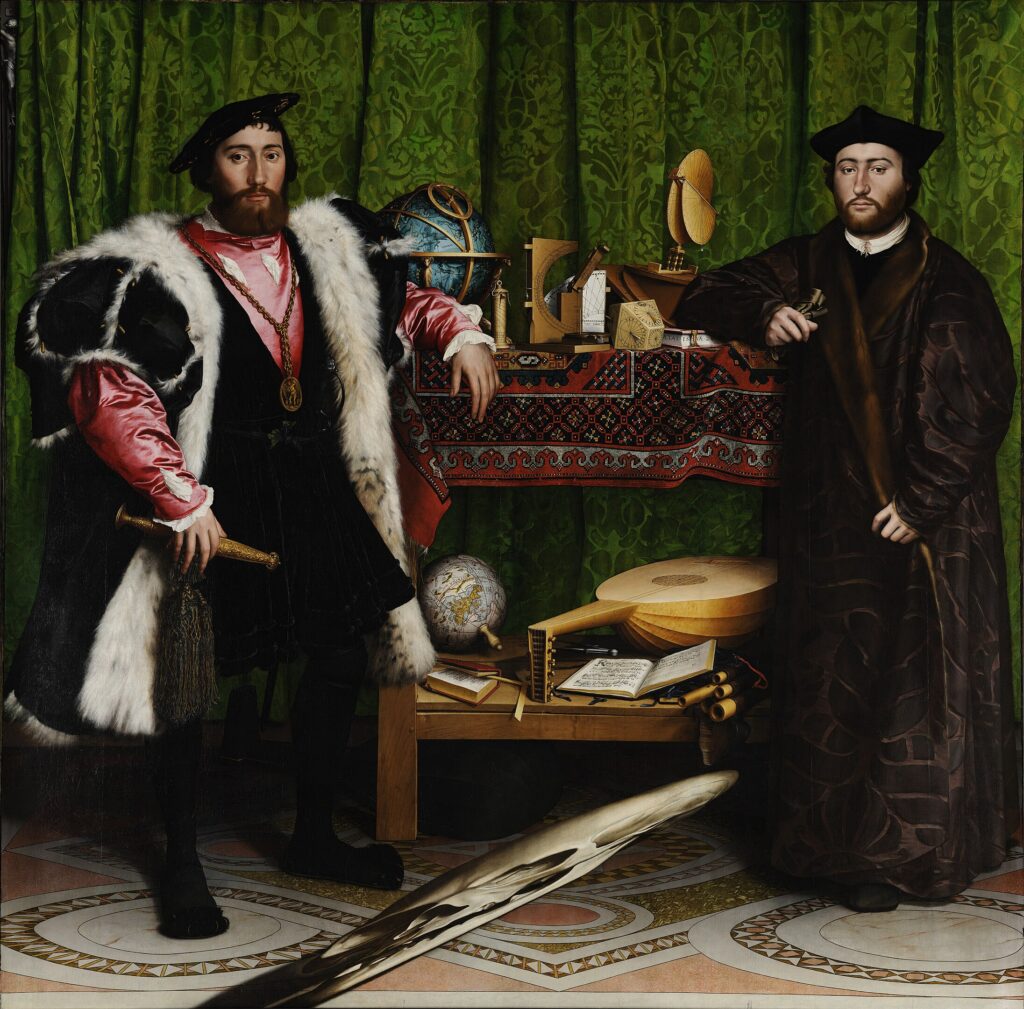
There’s a painting, made in 1533 by Hans Holbein the Younger, called the Ambassadors…
… it portrays two flash geezers surrounded by a charity-shop collection of stuff, but…
… have a careful look. You’ll see a distorted shape at the bottom centre that, when viewed from a particular angle, becomes a skull. The technique is called ‘anamorphosis’.
The skull is a memento mori… the inevitability of death amidst life’s pleasures. If that wasn’t enough, there’s a partially obscured crucifix in the top left corner… mortality and salvation…
… and we all thought it was just another painting of some posh blokes with more money that sense.
Perhaps you’ll be more familiar with The Scream.
Edvard Munch (1893). Four versions. The one, in the National Museum of Norway; in the top left corner, has Munch’s pencilled inscription…
‘Could only have been painted by a madman…’
… a response to critiques questioning his mental health.
Pictures so often with secrets, allegories and hidden messages. To properly enjoy them needs the help of an expert interpreter.
No different are the pictures taken of ourselves. Our innards, plumbing and workings.
That’s why radiographers and radiologists are vital to modern medicine…
… revealing and interpreting the inner secrets of our engine rooms and the articulation of our bits.
Increasingly, their role is forecasting. A modern day Haruspex, examining entrails… but pictures are more hygienic.
The NHS Breast Screening Programme, the first of its kind in the world, began in 1988. Achieved national coverage in the mid-1990s…
… free breast cancer screening-mammography every three years for all women, from 50 to 71yrs.
The screening done exclusively by women, on women, for women.
It’s grown its own specialism.
Mammographers, who perform and interpret mammograms.
I doubt the recent controversy, the plan to allow male staff to carry out the work, has escaped you.
There reason is simple enough, HMG, NHSE and the Royal College have taken their eye off the ball and there aren’t enough ‘ograpers and ‘ologists.
- Mammography; vacancy rates are high… 17.5% for screening mammographers, nearly 20% for symptomatic mammographers. The upshot… delays in diagnosis and treatments.
- Diagnostic Radiography; vacancy rates have increase from 12% to 13% over the past year, alone. As a consequence, some kit isn’t used to its full extent.
- Clinical Radiology; 31% shortfall in clinical radiologists, projected to rise to 41% within five years. Meaning extended waiting times for tests and delays in care.
Despite performing over two million diagnostic imaging tests a month the number of patients awaiting pictures is over a million…
… notwithstanding Our Great Leader boasting about an increased testing capacity (which, if the truth were to be told, was put in place by the Tories) is not keeping pace with demand…
… I think I’m right to say over three hundred thousand patients have been waiting six weeks or longer for key diagnostic tests .
Why the shortage?
The usual workforce story; The NHS is a rotten employer, too many newly trained radiographers leave the NHS within five years, probably off to the growing number of private screening companies.
In 2024, over 40 NHS trusts imposed hiring freezes on cancer and diagnostic units, to balance their budgets. Say thank you to the Treasury.
HMG says it plans to increase training places for diagnostic radiographers by nearly 40% by 2031-32… blah, blah.
I just wonder, will they be needed?
Imaging is one part of diagnostics that is already being supported by machine learning.
Numpties call it AI.
It’s actually pattern recognition and can already outperform or match radiologists in certain tasks, such as detecting; lung nodules on chest X-rays, breast cancer on mammograms, brain haemorrhages on CT scans, workflow optimisation, and…
… they can be used to prioritise urgent scans, reduce reporting backlogs and automate measurements… organ size, lesion growth and the like.
All of which comes with concerns about legal liability, regulatory approval and public trust.
Are the ‘ologists heading for the museum? An antiquarian profession?
No… complex, rare, or ambiguous cases will always need contextual judgment and integrating with patient history, lab results, and clinical context, but…
… have no doubt, the profession will change.
However, just like in a gallery, someone will still have to explain complexity…
…such as Jackson Pollock.
News and Comment from Roy Lilley
Contact Roy – please use this e-address roy.lilley@nhsmanagers.net
Reproduced at thetrainingnet.com by kind permission of Roy Lilley.
Related
Discover more from The Training Network
Subscribe to get the latest posts sent to your email.