Some say it will be run by PAs, AI and doulas.
But, really? Dunno…
… we might have been able to take a guess but now whatever future we thought we might have, is likely to be disrupted.
Why?
Globalisation.
Globalisation, has been very good to the NHS. Now, with a reduction in the interdependence and integration between countries…
… increasing trade barriers, tariffs, border controls, and focusing on national self-sufficiency the NHS will not be able to balance its books, fill rotas and stock its cupboards by drawing on global labour and global supply chains.
That all worked while borders were open, shipping cheap, geopolitics reasonably stable, Britain an attractive destination and…
… when economic policy wasn’t dictated by the White House and workforce capacity wasn’t the servant of confusing migration policy and public opinion.
The NHS world is looking flaky.
Around 325,000 NHS staff in England report as non-British. About 21%, and…
… 138,405 licensed doctors working in the UK have qualified abroad, 42%.
The UK’s medicines supply is described by HMG as;
‘… part of a ‘complex, global supply chain’.
Active ingredients linked to manufacturing in India, China, Germany, Italy and USA.
For the NHS, true autarky is fantasy. The only realistic aim is strategic resilience…
- enough domestic capacity,
- enough redundancy,
- enough stock, and
- enough trusted partners…
so that …
… a diplomatic row, trade dispute, cyberattack, migration unrest, shipping shock or pandemic does not leave hospitals short of people, pills or implants.
Workforce? The priority… grow our own. The existing (seemingly parked) NHS Long-Term Workforce Plan pointed to;
- 15,000 medical school places a year by 2031/32,
- 6,000 GP training places,
- 92% rise in nurse training,
- 22% of clinical training through apprenticeships by 2031/32.
- Reduce overseas recruitment to ~10.5% ‘over time’, compared with nearly a quarter when the plan was published.
Who knows what a new WFP will say?
It might very well say; more PAs, AI and doulas!
On supply chains, a House of Lords committee said;
‘…medicines security should be treated as a national security issue.’
They noted most active ingredients for medicines are controlled by China, India (neither with whom we have the most reliable of relationships) or other ‘single sources’…
… only about a quarter of the generic medicines used by the NHS are made in the UK… with more of Big-Pharma decamping to the US… draw yer own conclusions.
It recommended;
- a Critical Medicines List,
- an Application Programming Interface, (interconnecting systems),
- resilience-focused procurement and
- stronger UK manufacturing of generic medicines and ingredients.
Instead HMG is aiming for supplier-held-buffer stocks… (it’s cheaper to make the manufacturers hold stock) and some domestic, end-to-end vaccine manufacturing capability.
Nowhere near a comprehensive enough response. We should we be doing…
Five things…
- Publish a hard-headed Critical, NHS Inputs List of key medicines, APIs, devices, consumables and diagnostic reagents without which the NHS seizes up.
Not everything matters equally. Insulin matters more than office furniture.
Penicillin matters more than procurement rhetoric.
Such a list should drive contracts, stockholding and industrial policy.
- Change procurement. The planning guidance pushes systems to use consolidated NHS Supply Chain frameworks, which covers ~57% of NHS medical-device spend.
Procurement should buy not just lowest-price, but assured-supply. Sourcing UK or allied manufacturing options, transparency of origin, and surge capacity.
Cheap but fragile is not a bargain.
- Build selective domestic manufacturing. Not everything, just the things that matter most when the world goes wobbly…
- essential generics,
- sterile injectables,
- vaccines,
- PPE-grade materials,
- basic diagnostics and
- a shortlist of strategic devices.
HMG’s life sciences plan already links funding to future health-emergency resilience, support for generics and biosimilars.
This now needs to become an NHS resilience strategy, not just a brochure for industrial strategy.
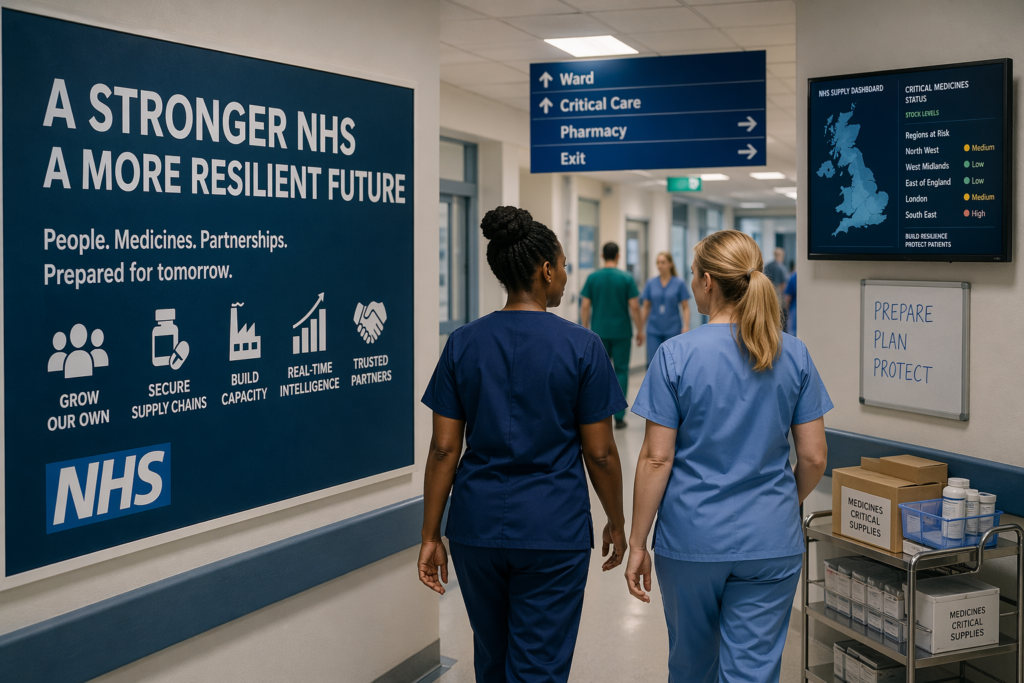
- Create real-time national supply intelligence. One lesson from repeated shortages is that the system is too reactive. Information too patchy. Create a proper command-dashboard…
- what’s short,
- where,
- how long,
- what the substitutes are, and…
… which hospitals are at risk next week, rather than last week.
- Keep the doors open to friendly interdependence. The answer to fragile globalisation is not no globalisation. It’s what Peter Drucker described as; fewer single points of failure, and deeper partnerships with dependable allies.
Government’s own medicines strategy says strong international partnerships are essential, but …
… what happens when the world disagrees, polarises and grinds to a halt? Dire Straits ‘Heavy Fuel’, is more than a song.
We must become far less naïve.
- Train more of our own.
- Keep more of our own.
- Make more of what matters.
- Stock more of what cannot be allowed to fail.
- Learn more about resilience, not just price.
- Treat more staff and medicines as strategic assets, not line-items.
Globalisation let the NHS live-lean.
Geopolitics means it now needs…
… to live-prepared.
News and Comment from Roy Lilley
Contact Roy – please use this e-address roy.lilley@nhsmanagers.net
Reproduced at thetrainingnet.com by kind permission of Roy Lilley.
Related
Discover more from The Training Network
Subscribe to get the latest posts sent to your email.