I been laid off from work
My rent is due
My kids all need
Brand new shoes
So I went to the bank
To see what they could do
They said son…
Money’s too tight to mention
Reeves, Starmer, Simply Red, with the anthem of our times, and …
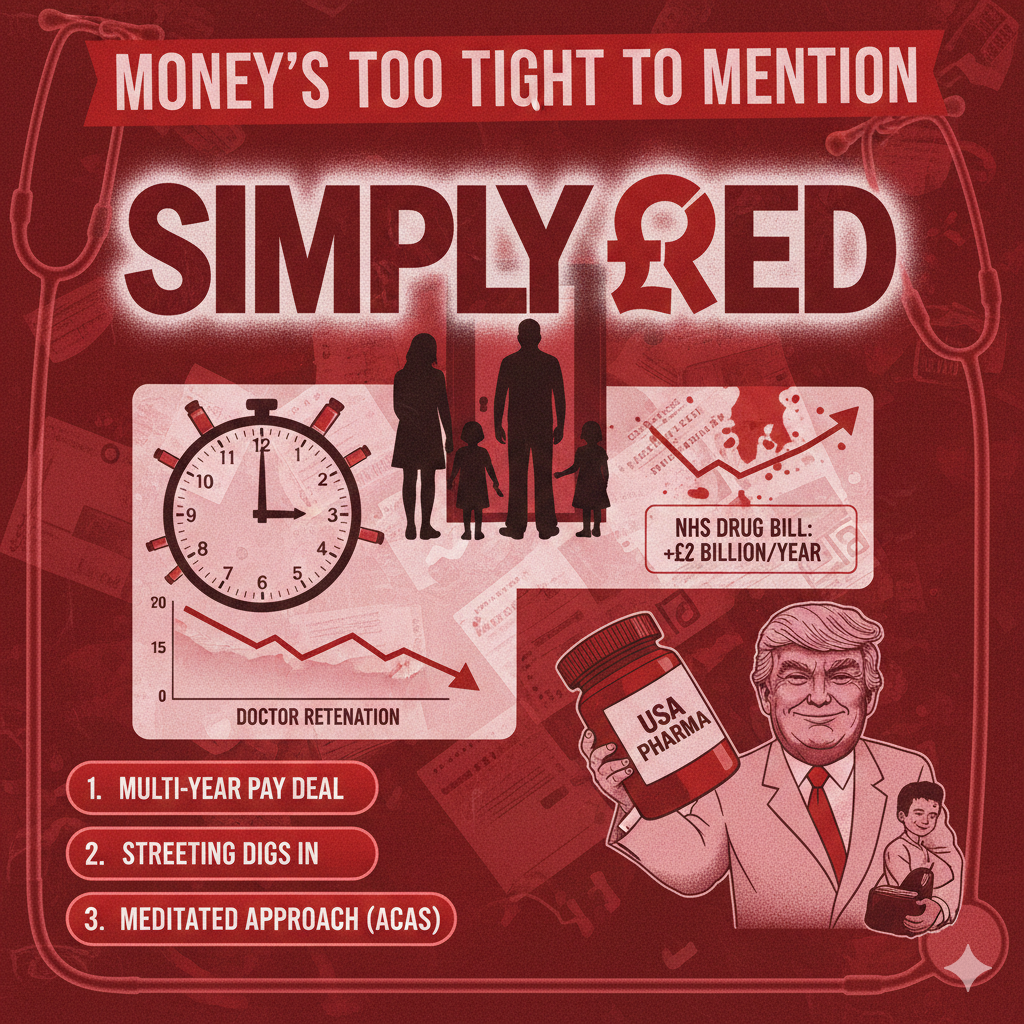
Yesterday, HMG agreed a deal that will see the NHS paying more for drugs, helpfully negotiated with the US administration that has made a hobby of strong-arming health systems into price rises.
So, we are paying more for medicines… at the exact moment we can’t afford to pay enough doctors to prescribe them.
Yesterday, resident doctors announce another strike. Streeting won’t talk to them. It is the public who are paying more taxes to, as the Chancellor put it, to‘protect public services and the NHS’.
Thanks to the trade deal, the US gets tariff-free UK pharmaceuticals while we get an evidence free raise to our NICE cost-effectiveness threshold to £25–£35k per QALY. A figure we haven’t had to raise in decades, and…
… yes, on paper, it’s overdue, but…
… not right now. Not without proper cost based evidence.
I’d guess the NHS now faces £800m–£1bn a year of extra drug costs because more high-priced medicines will clear the NICE bar.
Money that has to come from somewhere… unless NICE cheat and say new med’s don’t work.
So here we are:
- We can’t pay doctors properly.
- We can’t retain them.
- We can’t fill rotas.
- We can’t persuade them going on strike isn’t what doctors are supposed to do.
… but we can find £1bn a year for a drug-price rise.
You can almost hear The Donald;
‘…I told you, nobody negotiates drug prices better than me.’
He may not actually run the NHS but he’s certainly in charge of the drug bill.
Perhaps we could ask The Donald to fix the strikes? What are his options? Apart from calling in the national guard and making strikes illegal.
What to do? There are three options…
1.Multi-Year Pay Deal
Streeting offers a phased pay restoration over 3 years, to the end of the parliament, possibly combined with a nailed on commitment to the Ten Point Plan for non-pay ‘working lives’ conditions. Plus a commitment to training and job opportunities
Pros:
Immediate resumption of clinical activity; waiting list relief. Stabilises morale for junior doctors and … buys time for longer-term workforce planning.
Cons:
Adds £2–3bn in pay obligations over 3 years… depending on restoration speed.
If structural reforms such as training posts, retention strategies, aren’t funded, the underlying rot persists, and …
… it would create a precedent; short-term peace, long-term risk. Money is spent, but fundamental workforce instability remains unless the government couples it with credible structural changes, and…
… Streeting knows the maths don’t add-up. He’s left it too late to restore waiting target promises, by the end of this parliament. If he’s looking for an ‘out’… the strikes are tailor made.
2.Streeting digs in.
HMG refuses to move on pay; NHS emphasises continuity of service (elective procedures look like they are maintained at 93–95% coverage, but complex treatments still get strike-delayed). Strikes continue for a limited period; public opinion, media scrutiny, and union pressure mount.
An unpopular and incompetent looking government looks even more shambolic.
Pros:
Signals fiscal discipline; avoids immediately increasing long-term pay obligations. May push unions toward mediated compromise if continuing to strike reduces their leverage.
Cons:
Morale deterioration; potential increase in doctors leaving NHS (resignation, migration). Unrest with other staff whose leave is cancelled over Xmas because of the strikes. Backlog impacted in subtle ways, for complex patients.
Public backlash if NHSE can’t avoid visible disruption to services.
3.Hybrid, mediated approach via ACAS
Government and union enter structured mediation with ACAS.
Interim agreement reached… partial pay adjustment now, formal multi-year plan with transparent milestones, plus commitments on training, post-rotation jobs, and workforce pipeline.
Union halts strikes conditionally; monitoring ensures both sides stick to an agreement.
Pros:
Face-saving resolution for both sides. Allows integration with wider NHS reform agenda
Cons:
Slower resolution; strikes may continue until interim agreement is signed. Relies on government following through on its promises.
Despite the lack of trust in HMG, this looks to me the most viable option, but … success depends on credible enforcement and monitoring.
Streeting’s predecessor Steve Barclay’s belligerent approach to the strike forced Streeting, on coming into office, into buying off the Doctors.
This time his own hostile approach has made it impossible for him to negotiate and his bigger problems is, the nation’s bank account is
… Simply Red.
News and Comment from Roy Lilley
Contact Roy – please use this e-address roy.lilley@nhsmanagers.net
Reproduced at thetrainingnet.com by kind permission of Roy Lilley.
Related
Discover more from The Training Network
Subscribe to get the latest posts sent to your email.