I can feel a tension mounting.
The pressure is on.
We’ve had getting on for fifteen years of the same party in government and they are nowhere near ready for an election.
After fifteen years you might have expected a rhythm. A pace. A clear understanding of the character of the nation and our place in the world. Security.
Instead, we’ve had the bemused figure of the prime minister, at the end of the day, standing at a lectern, in the middle of the windswept street outside Number 10, telling us there are ‘forces that would divide the nation’.
Well, old-son, what’re you gonna do about it?
Get over it… he doesn’t know.
Telling us he, you, me, us, have a problem is all well and good. We know. It’s our lived experience… what does he want us to do? What’s he going to do?
Dunno…
Make it more difficult for us to protest? More laws about what we can say and do?
Probably.
Failing management always looks at in-puts (law) and outputs (arrests). They can’t do root-cause and outcomes…
… so people will rail against new laws, hey-presto more unrest, more dissatisfaction, more aggravation. Magic!
Politics is only management and communication. How difficult can it be for grown-ups?
In the meantime we have;
• Rip-off utilities
• Train fares… the most expensive in Europe
• Police services? Why bother? The percentage of crimes that were solved in England and Wales last year was just 5.7%
• A criminal justice system that makes snails look quick
• A Post Office that appears to me, first-class a delivering a packet of lies.
• Schools that are in disarray, preoccupied with surviving inspections.
• Holes in the threadbare roads
• Councils that are probably bankrupt
• Social care that has raised its entitlement bar to the point where probably 900,000 frail people no longer get any help and we wonder why they end up in A&E
• A cost of living crisis
• Almost a quarter of older Londoners living in poverty, and in the rest of England the figure is almost one in five
• There’s a war in Ukraine, that we are helping to pay for, with no end in sight
• The middle-east, a tinderbox, no one can stop what’s happening in Gaza
And, a knackered government talking about cutting taxes! Be ready to suspend disbelief.
The big plan to resolve all this failure? Cut public sector funding… and an opposition that are… well, bewildered is polite.
There is no prospect of resolving all this, if any of it, by the time the election comes.
In tomorrow’s budget expect the chancellor to tinker about and very likely blame the working population with talk about poor ‘productivity’.
A decade of; a global economic crisis, Brexit and Covid have left the UK seriously damaged.
Productivity typically strengthens in an expansionary phase of the business-cycle, because employers hold-off hiring more workers until they are certain about the economy.
The Tinkerman, fiddling with interest rates and shifting the tax-burden doesn’t stir my entrepreneurial old bones
Productivity is simply, doing more with less. To do that needs an expansion in the workforce, investment in skills, innovation and technology.
The whole of Europe has a problem.
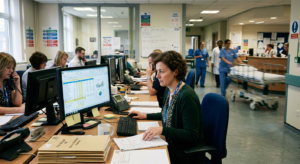
How do we fix it in the NHS? It’s easier to say how we don’t fix it. Not by sending threatening letters to trusts, trying to undermine their management and morale.
The NHS is a glorified production line… it’s called ‘flow’. Fix process management and you’ve probably cracked it.
The unpopular thought that boosting management numbers and improving operational capabilities is probably what’s needed.
Comparatively low levels of community nurses and allied health professionals responsible for rehabilitative care causes bottlenecks when it comes to discharge and their absence hastens admissions.
NHSE stopped publishing data recording which institution is responsible for delayed bed days in early 2020.
Have a look at Figure 19 in this excellent report from Reform; between 2010 until that point in 2020, the NHS was responsible for the majority of delayed days!
I wonder how much has changed?
If Trusts are pressured to hit A&E targets, for instance being told to focus heavily on non-admitted patients to hit the 76% ‘political’ target by diverting staff to less sick patients, that is route-one back to Mid-Staffs.
We all can see NHSE is under election-pressure and in a panic. Throwing their toys out of the pram. The upshot of that? Send for more toys.
Are there solutions… yes! Of course.
Although at national level A&E performance is in decline, some trusts perform significantly better than others.
Factors such as the hospital’s level of admissions, the inpatient care it offers, and the demographics of its local population may be variables.
But… it’s a fact, some Trusts are doing better than others. It’s called positive deviance.
Understanding that gives us a fast track solution… find out what they’re doing and show the rest. Look here.
Management by sharing the best.
News and Comment from Roy Lilley
Contact Roy – please use this e-address roy.lilley@nhsmanagers.net
Reproduced at thetrainingnet.com by kind permission of Roy Lilley.
Related
Discover more from The Training Network
Subscribe to get the latest posts sent to your email.