Think hospital and what comes into your mind’s eye.
Probably be a nurse, or a blue light. Maybe an ambulance or a stethoscope.
What it won’t be is a person hunched over a desk, working on the NHS equivalent of the Hodge Conjecture…
… which is eye-watering in complexity and requires a sophisticated understanding of algebraic geometry, complex geometry, and topology.
Put simply, solving this problem is like fitting together the pieces of a very complex, abstract jigsaw-puzzle.
This tortured soul will be working on the NHS Conjecture.
Put simply; how to spend the same pound twice or in more abstract terms how to make one pound become the square root of one pound and do the job of two pounds.
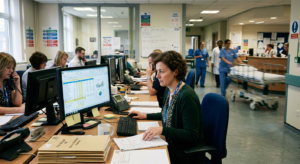
They are humble people. Lunch in a Tupperware box. Coat, draped over the back of the chair.
Their desk… littered with printouts, workings and spreadsheets that explore the archaeology of their organisation’s workings.
A pile of guidance-from-above with threatening demands for data, details and more numbers from organisations that give nothing back in return, but want it by Friday.
It’s always Friday.
The seat of the chair will be held together with heavy duty tape. The mouse-lead sellotaped and a pin board littered with post-it-notes.
The office will be in a port-a-cabin… temporary accommodation in 1994. Freezing like the Arctic in winter. A Nordic sauna in the summer.
These places are the engine room of the NHS, where the architecture of waiting lists is designed, caught-up, rescheduled, squeezed-in and fixed.
It is from places very much like this that theatre lists are manoeuvred, changed and somehow made to work.
It is from places very much like this that arrange for patient’s meals to arrive, floors cleaned, equipment maintained and bog rolls are in the lavatory.
It is from places very much like this that questions such as; how many, where, when and how much are answered, because no one else can.
Welcome to the world of NHS administrators.
The hidden army of heroic people that ensured the NHS functioned through Covid, winter pressures, heatwaves and no money. They keep the drains clean, the car-parks parking, the lights lighting and the grass cut.
They may not stand at the bedside but they do make sure bed spaces are cleaned. Ready with fresh linen, for the next occupant.
They do not administer drugs, but they do administrate the supply-chain that makes sure the the pills are there.
They don’t take blood samples but they are there to make sure the reagents are in the labs and the kit is working.
Without them, no one at the bedside would be able to do very much at all for the person in it.
They achieve all this mainly, with a biro and calculator. With spreadsheets they’ve concocted themselves they make hospitals work, with every ounce of commitment to the safety and safe passage of patients as any consultant or chief nurse.
Now we hear from our favourite finance director, NHSE’s Julian Kelly, that he is poised to take an axe to their number.
The impeccable chroniclers of all things health service, the HSJ report;
‘.. Kelly …addressing … productivity measures that would have to be taken in light of next year’s tight financial settlement… warned … next year’s envelope would have to cover all costs including pay deals and elective recovery…
… we need to focus next year to get all boards to look at their [workforce] establishment… particularly… “in their support and admin sides” … which he had claimed had “grown in percentage terms faster than other areas”.’
Without investment in modernising administration, without the capital to buy software and systems that work by themselves, the NHS Board must know, the NHS cannot function…
… sharps won’t be made to disappear, laundry laundered, new hips on the shelf and sutures ready for stitching them in. Gas and air for mums in labour, lavatories spotless, tissues ready for sticky bums and wiping away blood, sweat and tears.
The cause of Kelly’s tyranny?
Apparently Streeting is forcing [the] NHS to look at ‘everything we do’.
Let me help him;
NHS administration costs are about 2%-5% of the total budget, including management, planning, data collection, and regulatory compliance.
Germany spend about 8%, the US 25% and the NHS is always cheaper than multi payer systems.
So, go away and say sorry for unsettling everyone and think again.
News and Comment from Roy Lilley
Contact Roy – please use this e-address roy.lilley@nhsmanagers.net
Reproduced at thetrainingnet.com by kind permission of Roy Lilley.
Related
Discover more from The Training Network
Subscribe to get the latest posts sent to your email.