
The foundations to this story regarding NHS outsourcing and staff pensions are to be found at the Royal United Hospitals, Bath NHS Trust.
The source can be found here… and here… and in my inbox… which is why, I suspect, the story will be found to be more common than we realise.
If it’s all true, there’ll be no mystery about why people who work there are asking;
‘Hang on… what’s happened to my pension?’
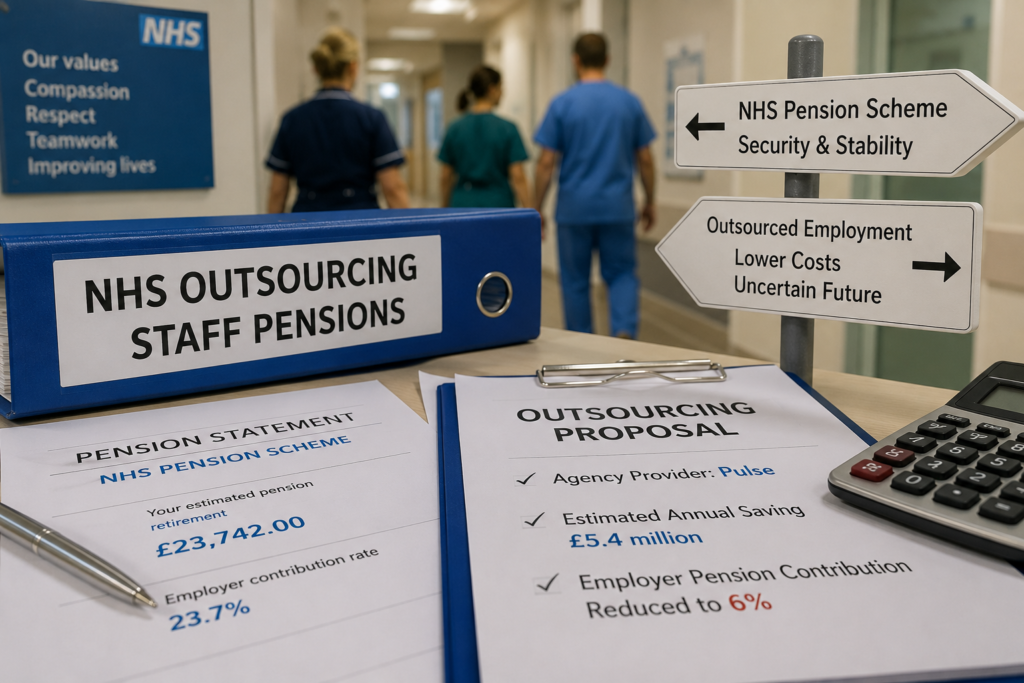
The Trust plans to outsource their temporary staffing operations to Pulse, a nursing agency owned by the private-equity-backed Acacium Group.
Entering a commercial relationship with organisations whose entire existence revolves around extracting value from labour markets…
… while the NHS itself barely understands the value of its own workforce.
This issue raises important questions about NHS outsourcing and staff pensions that cannot be ignored.
This brings to light the issues surrounding NHS outsourcing and staff pensions that affect countless employees.
The implications of NHS outsourcing and staff pensions are severe for the financial stability of the workforce.
Those involved in NHS outsourcing and staff pensions must be aware of their responsibilities towards employees.
Scheduled to take effect in August, the move aims to save RUH maybe >£5.4m annually by cutting workers’ employer pension contributions from 23.7% to around 6%.
Bank workers do not meet the legal thresholds for protected employment. Because of this, their NHS ‘flexible worker agreements’ will be terminated on August 1.
Without any choice, and to continue taking shifts, people must register with Pulse.
For me, this touches a nerve that I’d guess the NHS leadership class would probably rather leave untouched.
As explored in Relations, the NHS is increasingly redesigning workforce models around substitution, flexibility and cost pressure, often at the expense of long-term resilience.
RUH are not badly run in the caricatured sense, but one 2025 board-related document refers to ‘a further challenge to delivery’ of £29.7m in 2025/26 and reports a year-to-date deficit pressure of £11.7m.
The RUH annual report warns;
‘… increasing demand for both emergency and planned care is exceeding our capacity…’
Understanding the context of NHS outsourcing and staff pensions is crucial for current and future NHS employees.
Culminating in financial pressures and probably stick from the centre.
Many are unaware of the long-term effects of NHS outsourcing and staff pensions on their retirement security.
Why this matters beyond Bath
Bank people, flexible workers and temporary staff are increasingly being shoved into third-party arrangements and private staffing models where access to NHS pension schemes disappear or are diluted.
This situation highlights the risks associated with NHS outsourcing and staff pensions that many might overlook.
From a spreadsheet perspective, you can see why finance directors might be tempted.
Since the Thatcher-era reforms made Trusts separate statutory employers, the service can outsource, fragment and externalise parts of its workforce in ways previously much harder to imagine.
It’s not impossible to imagine whole departments being, quite legally, shipped out.
The employer contribution to the NHS pension scheme is now over 23%.
A huge number.
In an NHS where organisations are desperately trying to hit control totals, survive deficit pressures and absorb endless reorganisations…
… pensions start to look less like a workforce investment and more like a financial liability.
Staff become ‘cost centres’.
Pensions become ‘burdens’.
Loyalty becomes ‘legacy’.
As argued in Better, the NHS repeatedly reaches for structural fixes instead of dealing with workforce, infrastructure and operational realities.
Understanding NHS Outsourcing and Staff Pensions
The service functions because people stay longer, do more than they are paid for and tolerate conditions that would trigger mass resignations in other industries.
People believe they belong to something.
You can’t spend years telling staff they’re heroes, then quietly redesign employment arrangements that leave them worse off in retirement.
Well… you can…
…but eventually people notice.
Curiously, the people redesigning NHS employment models are rarely redesigning their own terms and conditions.
In every NHS reform, insecurity seems to travel downward.
For over thirty years reforms have chipped away at the idea of the NHS as a single coherent employer and replaced it with;
- a complicated market of trusts,
- subcontractors,
- framework agreements,
- agencies,
- bank systems,
- consultancy contracts, and
- outsourced functions.
Each individual change is presented as pragmatic.
Each one saves a bit of money.
Each one solves an immediate operational headache.
But collectively they change the character of the service, and how big systems drift.
Not through one dramatic ideological moment, but through thousands of temporary decisions taken under financial pressure.
The dangers of endless structural tinkering were also highlighted in Differently, where frontline NHS realities collide with policy churn and financial survival.
Pressure is what we now have
Ultimately, the ongoing discussions about NHS outsourcing and staff pensions must reflect the voices of those affected.
- Huge deficits.
- Unfunded redundancies.
- A reorganisation nobody fully understands.
- Ministers talking openly about AI substituting for labour.
These pressures are exacerbated by the ongoing challenges related to NHS outsourcing and staff pensions.
The workforce implications are already emerging in Worse, where retention, morale and the economics of NHS careers are becoming increasingly fragile.
The irony?
The ‘savings’ may prove illusory.
Lower retention, higher turnover, more agency dependence and weaker institutional loyalty are extraordinarily expensive.
The NHS has made this mistake before.
PFI looked affordable… until it wasn’t.
Endless reorganisations looked efficient… until transaction costs consumed the benefits.
Many argue that NHS outsourcing and staff pensions are areas in dire need of reform.
Now pensions risk becoming another example of short-term accounting triumphing over long-term system thinking.
Easy wins over defenceless colleagues.
Industrialised bullying.
Who am I to throw words against the winds of change?
It’s voices we need.
The ongoing debate about NHS outsourcing and staff pensions is one that requires public engagement.
Only through transparency regarding NHS outsourcing and staff pensions can trust be rebuilt.
The implications of NHS outsourcing and staff pensions should be at the forefront of policy discussions.
News and Comment from Roy Lilley
Contact Roy – please use this e-address roy.lilley@nhsmanagers.net
Reproduced at thetrainingnet.com by kind permission of Roy Lilley.
Discover more from The Training Network
Subscribe to get the latest posts sent to your email.