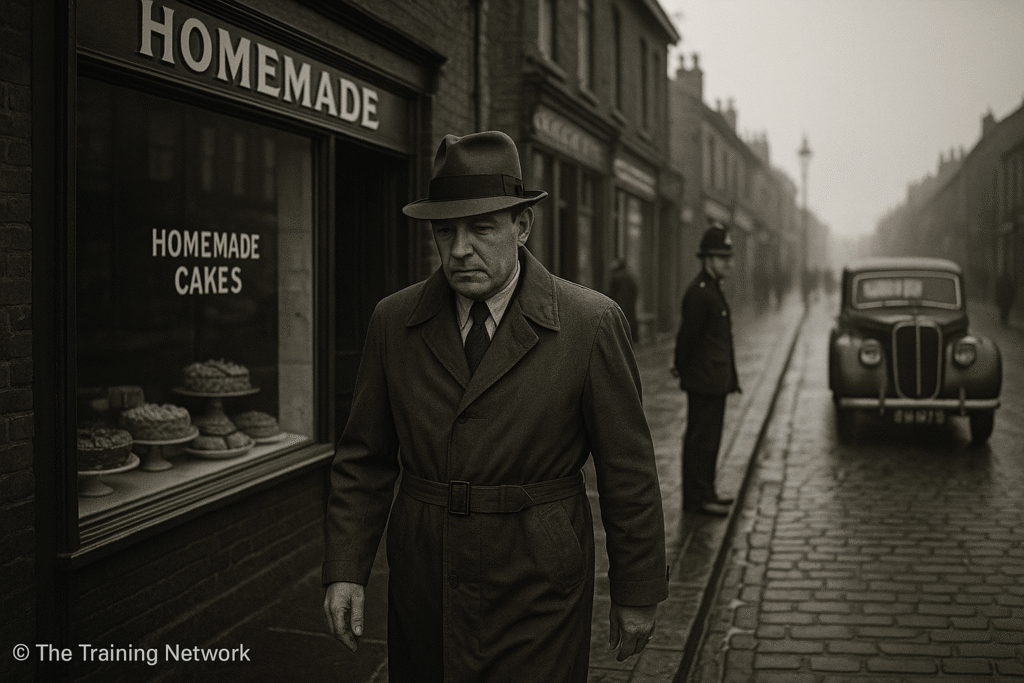
In the grey, post war-days when life was lived in monochrome, rationing was still in effect for many items…
… meat, bacon, ham, butter, cheese, and cooking fat. Sugar, tea, and sweets were also rationed.
Bread, which had not been rationed during the war, was rationed starting in July 1946, and remained so until July 1948.
Raincoats and trilby hats, the wireless and home made cakes.
The one ray of sunshine, the anniversary of which has just gone, 5th July 1948, the NHS was born. It was an uncomfortable birth, contentious but lifted from the shoulders of working people the worry of accident, illness and happenstance.
In the earliest days when Nye Bevan was trying to forge unity from chaos, he gave the new health service something remarkable…
…a forum.
Not a quango, a task-force, a dashboard, or a delivery board, but a forum.
A meeting place where everyone who mattered could be heard. It was called the Central Health Services Council.
Doctors, nurses, dentists, local authorities, voluntary organisations, all had a seat at the table.
The Council and its orbit of standing advisory committees, advised Ministers and helped shape policy.
It didn’t run the NHS, and it wasn’t perfect… but it gave the service something sorely lacking today… a sense of shared ownership.
Over time, the council was quietly swept away.
As Whitehall became increasingly managerial and target-driven, messy things like dialogue and consultation were replaced by delivery architecture and arms-length bodies.
Now, policy-making is done in silos, strategy is top-down, and consultation means a PDF with a deadline…
… and where has that got us?
An NHS in crisis. Industrial unrest. A workforce that feels ignored. Managers caught in the crossfire. Patients lost in the churn…
… and a total budget increase of 2.8% per year in real terms between 2025 and 2029.
Structural issues across the width and breadth of care. Threats of redundancies and plans for the next ten years that no one has the will, nor the money, nor the time, nor the inclination, nor the bandwidth, to get stuck into.
Perhaps it’s time to revisit the idea of a national forum? Call it The Grand Council if you like. Not to replace management or ministerial responsibility, but to connect them to reality.
A space for genuine dialogue. A way to test ideas before they’re launched. A warning bell before unintended consequences become front-page disasters… and a red flag for issues coming over the horizon.
The NHS is too complex for any one minister, boardroom, or algorithm to manage alone.
Bringing together clinicians, patients, managers, academics, carers, and communities in a structured, ongoing, rolling-conversation could help bridge the widening gap between the front-line and the centre.
The resident doctors strike is a case in point.
A Grand Council couldn’t solve their dispute but they could have seen it coming, because…
… the dispute is not just about money it’s about the manifestation of a myriad of annoyances that hack people off, drain their energy, make them leave and take the joy out of the working day.
The nurses, on the cusp of another dispute…
… a Grand Council would know about the NHS and its detail. Know it’s not really about the money… it’s about a system than buries the careers of the very nurses who are at the engine room of everything in the NHS.
I know, I know, we don’t need another committee… but we do need a fresh start. Find a way of reconnecting the decision makers with the people who are seldom the beneficiaries of their decisions, more likely the victims.
We need a council of sense not more senseless initiatives and guidance.
One that listens, challenges, debates and helps the NHS stay grounded in what matters most; the people who use it, and the people who make it work.
It worked once but was swept aside by managers, special advisors, whisperers and ineffective Boards. Buried in a landscape of silos… and we are no better for it.
It might just be what we need again?
Could it be any worse?
News and Comment from Roy Lilley
Contact Roy – please use this e-address roy.lilley@nhsmanagers.net
Reproduced at thetrainingnet.com by kind permission of Roy Lilley.
Related
Discover more from The Training Network
Subscribe to get the latest posts sent to your email.