Twenty years ago, one of the ugliest and bloodiest industrial confrontations was being fought, literally, at the Orgreave coking plant in South Yorkshire.
Five thousand pickets from the National Union of Mineworkers faced six thousand police officers, amassed forces from all over the country.
A medieval battle ensued. Armed with batons, bare hands and horses, the two sides charged, skirmished and fought toe-to-toe.
By sundown, the green fields were stained red with blood. Industrial relations were never the same.
Public opinion was initially divided but, over time, turned largely against the miners.
Why?
The strike was not backed by a national ballot, weakening democratic legitimacy. Violence on the picket lines alienated the public.
Media coverage portrayed miners as aggressive and unreasonable, allowing the government to frame it as a battle for law and order.
The government of the day knew the strike was coming. Some say it provoked it. They stockpiled coal to outlast the strike. Power cuts didn’t materialise, and the public became less sympathetic.
Within a year, the confrontation fizzled out. Miners drifted back to work. The strike collapsed.
In 2002, UK firefighters went on strike.
The public were initially supportive, but it declined. The use of antique Green Goddess military vehicles was a PR masterstroke that drew attention to the risks of reduced fire cover.
HMG successfully portrayed demands (a 40% pay rise) as excessive. Media focused on public safety and disruption. The upshot—a smaller-than-demanded pay deal.
Strikes end if public support is lost. When:
- Essential services are disrupted
- The demands appear excessive or unreasonable
- There is violence or militancy
- There’s no clear justification or legal basis
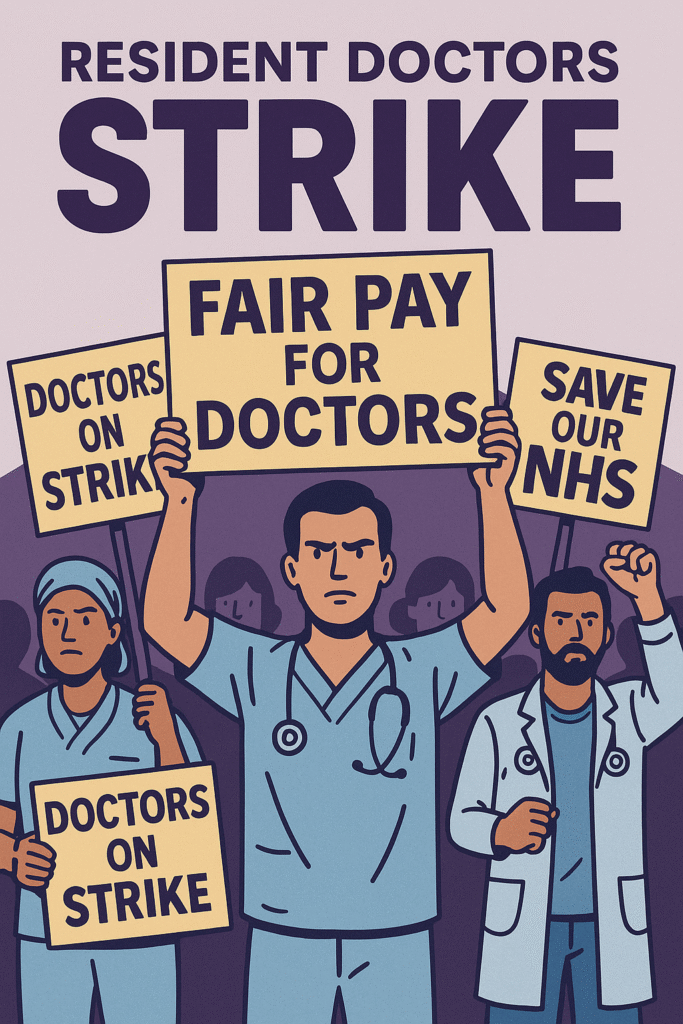
Which brings us to the resident doctors’ strikes.
Streeting can’t ‘store-up’ operations like piles of coal in the miners’ strike.
NHSE policy started out as, ‘business as usual’, essential services would not be disrupted… ‘come in for your operation as normal’.
Then it became, the strikes are perilous, putting lives at risk.
Over the weekend, it changed again to; ‘brace yourself’, this is disruptive and will carry on until Christmas.
It’s a brutal fact: if the public experience no disruption, their opinion is unlikely to crystallise one way or the other. That benefits the resident doctors’ claim they ‘do no harm by striking’.
NHSE’s confused policy and mixed messaging will prolong a strike they have no power to settle. Only Streeting and the DH+ can do that.
NHSE should quietly go about their business. Focus on the best productivity they can muster. Not become embroiled, as they will have to restore some sort of collegiate working when these divisive strikes are over.
Excessive demands? The £numbers in the resident doctors’ claim are disputed and complex, making it hard for the public to judge.
Their actual message is: ‘pay restoration over time’… they’ve said they don’t expect it in one go… that opens the door to a three-year deal and could keep the public neutral.
There’s no violence.
BMA militancy is carefully gift-wrapped by their spokespeople, who are articulate and better informed than most journalists. There are no loud, shouty, macho voices… smart move.
The strikes are perfectly legal, right up to Christmas.
Generally, people sympathise with NHS staff—especially post-pandemic. There’s a sense resident doctors’ conditions are poor and they are responsible for life-and-death decisions.
Trust in government is at an all-time low.
Starmer has little support for anything.
Streeting is seen as belligerent. Resident doctors’ claim that he has not delivered on the ‘conditions’ element of the settlement from their last strikes is correct.
Confidence in HMG to handle the NHS is low…
… unplanned, chaotic NHS reorganisation, redundancies and all the stuff you know, only too well, have soured staff attitudes. Other unions are rumbling about more strikes.
Applications to become a nurse are one-third down.
Do the resident doctors risk losing the room?
Sympathy is fragile… but…
… if Streeting is seen to do nothing constructive, public opinion will turn on him.
At the moment, doctors still have something HMG doesn’t… public trust.
Streeting can’t shift the headlines to say… ‘cancer ops delayed’, because NHSE have said they won’t be and are hell-bent on keeping the lights on in the operating theatres and patients wheeled through the system.
Look carefully. Opinion polling is not conclusive:
- 49% say salaries are about right
- 51% say they ‘deserve’ more, or ‘could be’ paid more but not 29%
This is a quiet nod of sympathy.
And… mobilising anti-strike sentiment isn’t easy. At any given time, only ~3% of the population is actively using NHS services.
Most people’s view of the NHS will be based on their last encounter, which is likely to be a picture of hospital staff rushed off their feet and struggling.
If the BMA can keep their strike as a battle between medics and ministers… Streeting loses.
If it becomes a fight between medics and the public… it’s already lost.
Strikes don’t end when people shout.
They end when people sigh.
News and Comment from Roy Lilley
Contact Roy – please use this e-address roy.lilley@nhsmanagers.net
Reproduced at thetrainingnet.com by kind permission of Roy Lilley.
Related
Discover more from The Training Network
Subscribe to get the latest posts sent to your email.